
We’ve all seen it.
A beautiful period gown spoiled by a limp, dragging skirt. Besides good flatlining in that skirt, the use of petticoats can take that loose mess and make it a beautiful reproduction worthy of a fashion plate.
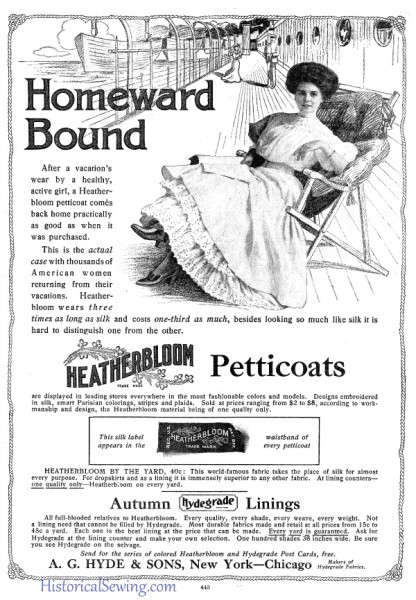
This is one of my biggest pet peeves (and one of the Biggest Mistakes) when admiring reproduction historical clothing – being able to tell where there is a shocking lack of petticoats. A woman may have the most beautiful gown, the correct silhouette, and fabulous accessories – but it can all fall flat if she doesn’t have enough (and I do mean that) petticoats.
One petticoat usually doesn’t cut it.
(I’ll let the “one” slide during the Bustle Era as a wired bustle with ruffles covering the wires is like the first petticoat. Throw just one more petticoat on top and you’re good to go in many instances.)
The worst offense is when a hoop skirt is worn. Have you seen a Civil War or 1860s skirt where a distinct wire row is visible about 6″ to 12″ above the hem? (yikes) Sometimes the row is seen even with a petticoat. That one petticoat is not enough! Obviously.
So I’ll shout: It really IS ok to wear multiple petticoats!!!
- They won’t hurt.
- Multiple petticoats are period correct.
- They make your costume SO much better.
If you’re worried about adding to your waistline with several thick waistbands under your skirt, set the petticoat panels onto a yoke or set them all together onto one waistband. Brilliant!
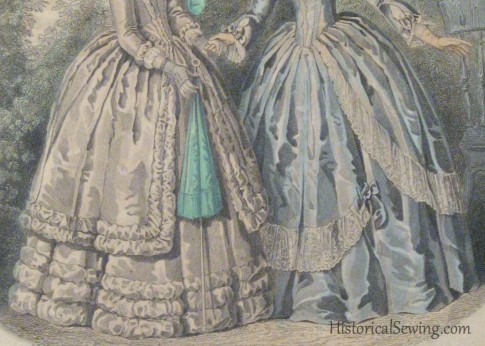
The two early-1850s skirts below would not have that gentle bell shape without the use of multiple petticoats supporting them underneath. Like, several of them.
I just cringe when I see a fantastically made 1890s gown only to notice the skirt falling flat against the wearer’s legs (I’m guilty of this too.). Even if the skirt has all the proper panels, the full hem width, and stiffened hem facing, it won’t cut it for achieving that beautiful flared 1890s silhouette we love.
The problem is, simply, NOT ENOUGH PETTICOATS.
Listen. Our ancestors knew the secret to a fashionable silhouette. They knew that you won’t look the same with just a skirt about you, over your chemise and drawers. They knew the extra foundation skirts, cut just so, would show the world your fashionable eye.
And isn’t that what we are striving for? The fashionable silhouette?
So many problems can be solved by adding an extra petticoat – I challenge you to try it!
That airy ball gown skirt will stay put; the bell shape you desire will form; the cold air you feel will be dispelled; that train will lay flat…
Plain, corded, ruffled, trained, gored, tucked, paneled, shaped, tied – you name it. That extra petticoat or two could be the missing element of your costume. Give it a try!
What are your thoughts on petticoats? Please leave a comment below.
P.S. I love petticoats and have given you more resources to make them up. Take a look at my post on good fabrics to use for them and then how to starch petticoats when finished. If you’re new to historical sewing, my list of patterns will help – including many for you to create petticoats with. 🙂
ADD THE PETTICOAT!!
I realize I am posting quite late, but I will add it anyway. I went back and re-read all the “Little House” books when I had daughters, and was surprised at how much I caught as an adult.
In the book “These Happy Golden Years” which details Laura’s late teens, courtship, and marriage to Almanzo Wilder, there is a scene in which she describes dressing for Church on Sunday morning. And remember, these were ladies on the *frontier. Yes,De Smet was a small “town”, and a railroad stop, but it was NOT St. Louis, either!
This would have been circa 1885, or so. She was born in 1867 and married at 18.
She describes putting on SIX starched * ironed * muslin petticoats, as. well. as. hoops* !!
Two under and four over the hoops as I recall.
The “hoops” were what we might call “crinolines”, dress shapers and bustle support, not the Civil War Era saucers. Laura, being a petite and sensible girl, “did not like a large bustle, and so buckled the tapes (of the bustle) in the front (of the crinoline), so the dress would fall smoothly”. Hoops. Plus six petticoats. And the dress. Hat and gloves. Shoes.
The next time you grumble at folding the laundry in your yoga pants, be grateful you do not need to sew, wash, *starch, and *iron 3-6 + petticoats for yourself and your mother and three sisters. Wool and quilted petticoats were winter staples. And this was done *before Charles traded a cow for a sewing machine for the family. $$$ 😵
ADD THE PETTICOAT!!!
LOL. Petticoats make all the difference. 🙂
I some time wear ladies fashion from 1910, skirt bodice and petitcoat, do reenactment of the era. most of the time I loan the costume.
Hi, bit new to this and for my A level Textiles I’m making Janet Arnolds patterns of fashion 2 1893 evening gown, the pattern says it would have been worn under a gored petticoat with frills, any recommendations on how many gores, what frills and if the one petticoat will do and any recommendations on patterns? Also its not stated in the book but I know that bustle pads where still common in 1890s would you recommend making one for the dress
sorry for throwing multiple questions at you, Thank you 🙂
General skirts of that decade had 5 or 7 gores, and petticoats could too, or they could simply be a front and back panel or three gores. With the wide flare silhouette of the 1890s, I recommend at least two petticoats. Frills (aka ruffles) were kept to the lower third of the skirt, or below the knee. Some had multiple, narrow ruffles while others a single, deep ruffle. You can see more on my Pinterest board. Petticoats became REALLY fancy in this era! Bum padding was still worn to smooth out the back of the skirt and help with the hem flare. The shape, thickness, and even IF it was worn would depend on the natural figure of the wearer and the attempt to achieve the fashionable silhouette. Best of luck with your project!
Thank you so much for this it’s a great help, I didn’t realised how much of a rabbit hall you can fall down for historical sewing
Oh, there are deep ones. Pick a topic and go! 🙂
Hello, how many petticoats would you suggest for an 18th century gown being worn in fall? I’ve been thinking about 4, with thicker stockings, but I totally think more could be worn (or less).
In my research, not a whole lot of under-petticoats were worn at that time. I’d recommend two: a quilted petticoat (for warmth) and one on top of that to smooth it out. Then your dress/gown petticoat on top. Sometimes you may only need that quilted one, but play with the silhouette, too. There’s no rules to follow.
Hi,
What would be the best petticoat pattern for Edwardian walking skirt please?
Thanking you in advance.
As a “cheat” method, you could use the skirt pattern for the petticoat and simply make larger seam allowances (to reduce the overall skirt width to lay better under the dress skirt. It will also depend on which years of Edwardian you are looking at. Early era (first years of 1900s) have a completely different skirt shape to later years (1909-1912). For early-to-mid years, try the Past Patterns one. Or go for the Truly Victorian petticoat for the slimmer silhouette.
Would it be ok to wear less petticoats in the summer? I’m making a crinoline costume for this summer and I’m wondering how many I should make.
Absolutely! It’s what our ancestors did to deal with warm weather. I like a good, light petticoat with ruffles for the summer. Use organdy for light weight and natural stiff support. 🙂
This makes sense! I have a gorgeous 1890s walking suit, but my skirt always seems to be showing my legs. I had on 2 petticoats.
Is there an 1890s petticoat style you may recommend?
Also, what is the best waist closure for them? I have 2 drawstring.
Slowly working on a new set of undergarments and a few really pretty petticoats are on the list.
And thank you for the amazing resources on the website here!
Thanks for reading, Julie!
The Truly Victorian 170 is a good base. Add a second layer to that wide, lower ruffle as you can see on originals. Be sure to starch them! That helps a lot.
Many original petticoats had drawstrings just at the center back to close or only in the back sections; the string or tape didn’t go around the entire waistband. A drawstring helps with waist adjustments/weight fluctuations. If you don’t want the bulk of a drawstring knot then set on a flat waistband, overlap and close with hook & eye sets.
Thankyou for this information
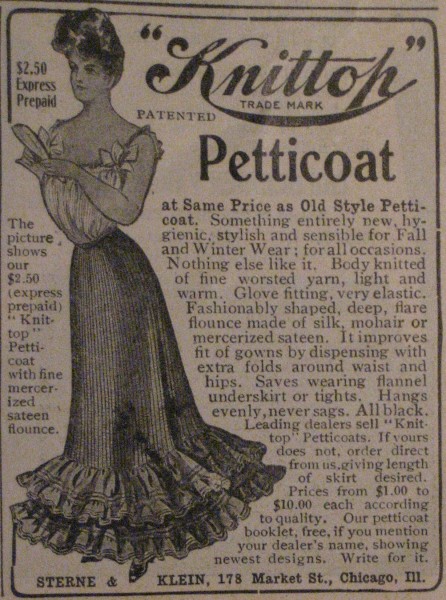
I had no idea about knit petticoats! That could make it easier to get the slim fit in the upper part of the skirt that gives oomph to the flare at the bottom. What about using lighter weight knits like cotton jersey for summer? Even if it wasn’t historically correct,it would be nice for costume wear!
I know one of the Norwegian national costumes may have seven – 7 – petticoats to get the right shape and stay warm in winter. It’s from the second half of 19th century (?) (1850-1900)
Yes, undergarments are VERY important, unfortunately I find it hard to find any reliable sources for exactly what was worn. Often I will just see references to “petticoats”, without mention of what type or how many.
I stumbled across this page looking for information on making my first bustle skirt, and see you have lots of useful information. Thank you! Also, if you know of any other good resources for underpinnings I would be happy if you would like to share.
We all see fashion plates for the wealthy but I wonder what the ordinary people wore. E.g. In the 1860s did the farmers wife wear a hoop and several petticoats. Or did they have just one petticoat?
Oh, multiple petticoats would have been worn. Poor women might even still be wearing a corded petticoat instead of a wired hoop. I briefly discuss this in my post here.