
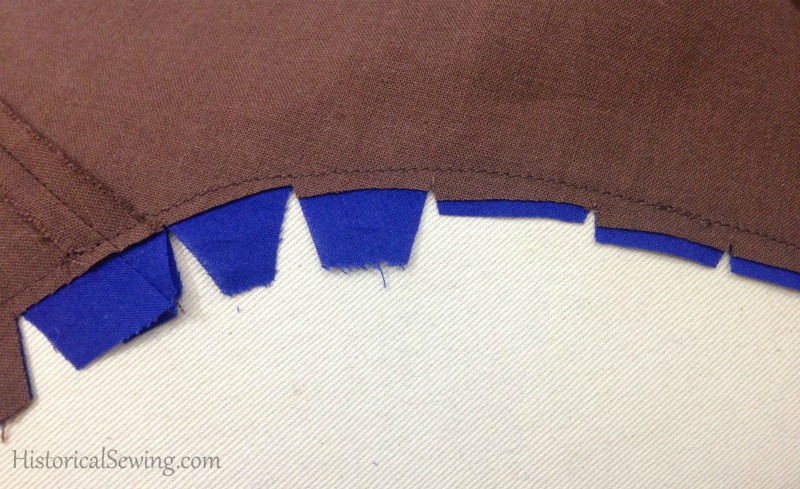
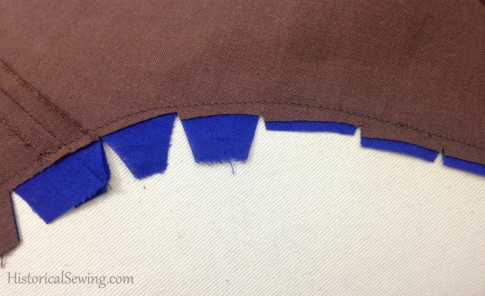
Do you make the grade? It’s super important to get into the habit of grading your seams, and I highly recommend it!
The process of grading your seam allowances (aka trimming to various widths) is fairly easy to understand. However, this sewing technique can be time consuming. But don’t let that stop you!
Making the effort of this step in your sewing will create a tremendous difference in how your seams lay and contribute to an overall professional appearance.
The grading term comes from industrial construction and landscaping and is used to describe the horizontal levels of a hill or building – the slope. In sewing, this translates to trimming your seam to various levels making each layer of fabric a different width. Doing this reduces bulk within the seam area – thereby creating a flatter appearance.
How to Grade Seam Allowances
S.A. = seam allowance
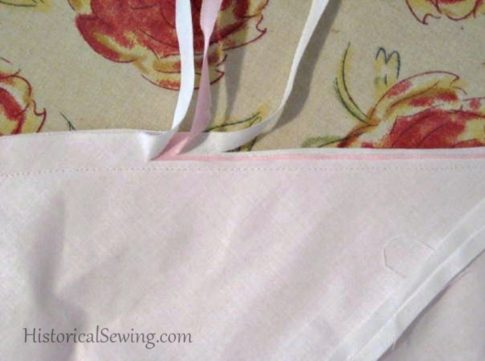
Above photo is a skirt facing (top layer) sewn to a skirt (bottom white layer) that has been flatlined with pink silk. The facing is trimmed the closest to the stitching and they other layers trimmed a bit wider than the one before it.
- Sew the seam first and press flat.
- Starting with the S.A. of the lining or innermost layer, trim close to stitching.
- Trim the next layer close to the first trimmed layer but leave the allowance a bit wider.
- Repeat with the remaining layers until seam is completely graded.
- If you have several layers (e.g. 5 or more), grade S.A. down to about 3 main levels. The last layer of S.A. may not be trimmed at all because the original S.A. width is perfectly in line with the other graded layers.
- If your seam is curved, you can grade either before or after you clip the S.A. (I do both ways depending on the project.) It is a personal preference and one you should do that comes easiest to you as you sew.
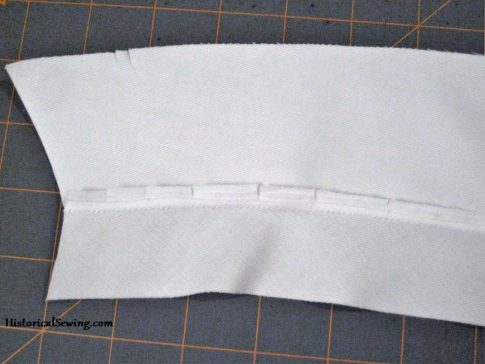
Above is a center back bodice panel sewn to the facing. The seam finishes the back edge. It has been clipped at the curve and graded. The facing will be folded toward the back panel and the seam pressed flat.
Nearly all seams should be trimmed, even a little, to smooth up the cut edges. If you are trimming down to 1/4″ or narrower, don’t grade. Any trimming, grading and clipping into a seam allowance will weaken it.
For future adjustments on costumes that will be shared or if there are weight issues you want to allow for, you can leave the seam allowances on the major bodice seams untrimmed.
Grading seams should, and can, be done on most seams. Any seams that will be enclosed, such as those on cuffs, collars, facings, underlinings and linings require grading to lay smooth and flat.
However, not all seams need to be graded. Skirt seams, for instance, do not need to be graded if the skirt is unlined.
What other tutorials on sewing would you like to see? Please contact us with what you need to be successful in your costume sewing.
I’ve got a skirt that is two different skirts sewn together in the same waistband. Before I enclose the band it makes sense to grade the seam allowance, does it change it all that they are both pleated? Not pleated together, although I’m curious to know how you would do it if they were pleated together. Obviously there is a lot of bulk.
I grade as usual the best I can. Some of the pleat layers will be trimmed the same. I’ll make vertical cuts in the fold ends of the pleats to help me grade the layers. Even some grading will help with a flatter seam allowance within the waistband.
Yay, it makes sense! Thank you! To clarify– when all the layers are graded and turned right way ’round, should the widest allowance end up closest to the fashion fabric? I think that’s what the examples show. And I think it would keep the layers from showing through. Is that right?
You are absolutely correct. The longest side is the the one next to the fashion fabric (generally the fashion fabric part of the seam allowance.
Is there no risk for fraying? My old teacher insisted all edges must be zig-zagged to avoid fraying. Admittedly that was for regular dressmaking class, not historical, but I still hear her draconian voice in my head. Are you telling me I’ve been zig-zagging for nought?
Nothing wrong with zigzagging the edges! Depends on the fabric, really, as to how you treat the raw edges. This article might help you on that. But grading is best on seams that are enclosed – like collars, cuffs, hems with a separate facing, opening edges like plackets or bodice openings, etc.
I’m confused. In this post you say you usually clip first, then grade. But another post on “Tips for Faster Sewing” (which links to this one) you talk about grading first, then clipping. So which one do you do?
Oh! So sorry for the confusion. Thanks for asking for clarification. Yes, I do mention both ways. However, I most often clip first then grade because it’s easier to make the clips in a full-width seam allowance, and they are more accurate and deeper towards the stitches. But it takes more time. To shave off a few minutes you can grade the seam first.
Great post! I agree grading gives garments a nice professional finish! Worth taking time over.
Thank you yet again.
I have never caught on to any other explanation of seam grading. Now it’s perfectly clear and understandable! I’ve been watching Cosmos, and I’m now convinced that you are the Neil deGrasse Tyson of sewing – taking incomprehensible concepts and explaining them so clearly that they suddenly make perfect sense!
Thank you for that! Glad this tutorial helped you!
Thank you! I’m working from a McCall’s contemporary pattern and could not understand at all the included directions for grading seam/interfacing–this is the only instruction/explanation I have found that made it clear and understandable –and no longer a scary prospect! I am bookmarking you in my ‘helpful sewing advice’ folder.
Thanks for this reminder on grading! just what I needed today as I have a pair of wool pants lined with flannel I need to finish and was wondering about grading. Usually I skip it on simple pants but these are weighty! A snipping I will go…