
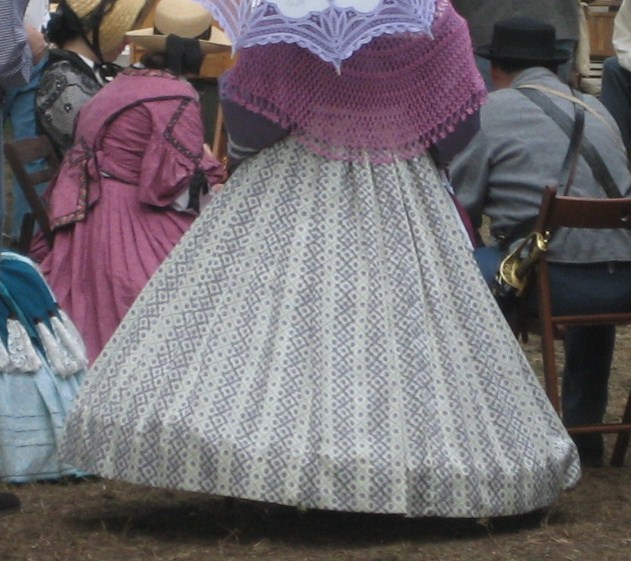
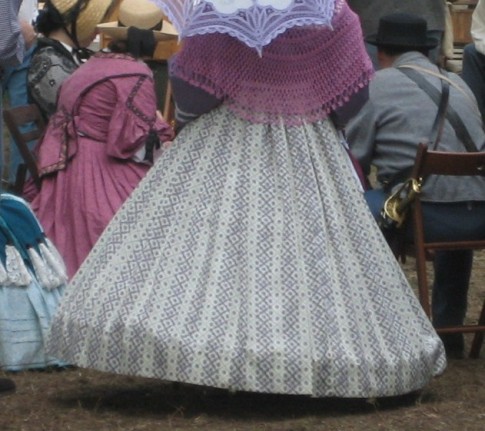
Successful historical costuming begins with the silhouette (among other things). When the dress is “just not right,” take a look at how it appears. Sometimes the proportions are off. Sometimes the undergarments hang funny. Other times it’s simply the support shape the entire costume is built on.
Reproduction hoop skirts from the Mid-Victorian era, the late 1850s & 1860s, are often known for hanging badly and being of a weird shape. Perhaps you’ve seen a few at Civil War reenactments. One of those unsightly forms is known affectionately as “the lampshade.” And it is not a good period correct look.
A lampshade silhouette is where the skirt hangs out from the waist, falls inward to the body about thigh level then curves out and over the lower hoop wire row. (Inexpensive modern bridal hoops are infamous for this look.) What you want is a dome (early years) or pyramid shape (later era) of the skirt.
.
Use these 3 tips to avoid looking like a light bulb topper.
1. Adjust the bottom hoop circumference. Do this by making the length of the wire shorter – but don’t go cutting the wire! Simply push the wire ends past each other in the casing of the skirt, overlapping until the skirt falls in an easy hang, proportionally in line with the wires above it.
The key here is to not have that lower wire so much bigger than the one above (like in the photo above). Once the wires are overlapped enough, control this new circle frame with masking tape, duct tape, or if buckram covered wire, poke two holes in the center and either sew together or use a twist-tie to secure. (HeHe, gotta love modern solutions!)
2. Add another wire row to the mid-section of the hoop. When you’re wearing the hoop, about where your hand falls to your side is where the lampshade style will sink in. Much of this is caused by a heavy skirt but also because there’s not enough wire support at this level. Sew in a new casing with twill tape and add hoop wire. Remember to overlap the ends and secure with the above instructions.
3. My personal favorite – Add another petticoat… Or two… Or three. Seriously. In fact, listen to what May said just this week:
“Just made one simple petticoat for my regency ball gown and it completely changed the silhouette.”
Yes, petticoats DO make a world of difference to your historical costume silhouette. Use them. Repeatedly.
A good ruffled petticoat followed by a smooth, plain one will help immensely in hiding that lampshade profile. The ruffles should be thick around that mid section too to support the skirt so it doesn’t collapse inward. And remember to make sure the petticoat hangs lower than that bottom wire so you don’t end up with a “break line” in your skirt.
Have you used one of these tips to fix a lampshade silhouette? What other tricks have you used or heard about?
I need help! Trying to figure out how to fix the break line in my daughters sweet 16 gown I keep trying to share the picture here but it’s not letting me.
Shortening/overlapping the hoop ends and adding a ruffle or petticoat will help with a break.
You may email me at sewing @ historicalsewing dot com with your photo and I will try to help further.
I’ve participated in civil war reenactments for the past couple of years, though I’ve borrowed much of my costume. The only thing that was mine was the outer dress and hoop skirt. I have been trying to figure out how to solve the ‘lampshade effect’ and this post helped me immensely. But being a heat stroke-prone 15 yr old, I haven’t been wearing petticoats. Realizing now that the root of my problem is probably the lack of petticoats, I need to make some.
Is it possible to make a petticoat out of a flat sheet with a 2″ casing at the top with a cord running through the casing (making it adjustable)?
Would this work as an over and under petticoat? (meaning I could use the same pattern for both types of petticoats.)
(And because I have limited money and sewing experience), would adding ruffles to the petticoat approximately where the hoop wires are, make the dress look better?
Would a silkyish fabric work or would I need something stiffer?
I have lots of questions and with my mentor in civil war reenactments living 3hrs away, I figured to ask them all at the same time.
Hello! So glad that this post has helped. Yes, ruffles on your petticoat will help smooth out the wire lines for sure. For the waistband, 2″ is a bit too wide; I suggest more like 1.25″ or 1.5″ wide. You can make it with a drawstring, but I’d recommend a flat grosgrain ribbon or twill tape about 3/8″ or 1/2″ wide instead of a cord. Cotton or linen twill tape is preferred. Cut the waistband simply a few inches longer than your waist measure so when you use the drawstring you won’t have so much bulk under your skirt. Although fitted waistbands are seen more often in the 19th century, a drawstring one is perfectly appropriate for all your petticoats.
Good luck with your silhouette sewing!
I am having time trying to make my skirt fuller and have more of a bell shape. My skirt is made of a heavy upholstery fabric with a tie string waist. The bottom of my skirt measures out to 127 circumference. I just recently purchased a 4 bone hoop skirt with the bottom hoop being 120 circumference and my outer skirt just hangs on itand is baggy . I am trying to figure out how to get at least 5-6 more inches under it hoping that will help. I am not sure what to do should I get a crinoline . Help me please. Any advice
Your hoopskirt should always be smaller in width than your skirt. The skirt should not be tight around it but lay nicely on top. A few folds here and there are ok. Adding a couple of good petticoats (one with deep flounces) will help your silhouette immensely.
I agree that modern hoops are way too long! I am 5’5 and I took out the top rung and threaded the drawstring though that opening to make it shorter. This gives a period correct length and silhouette. :o)
I finally got around to watching ‘Gone With the Wind’ last week and I noticed you can actually see a lampshade hoopskirt in a few scenes … but these are scenes where it’s plausible for it to occur. The first is when Scarlett is working as a nurse during the Civil War, when not only would fabric have been rationed, but if she were wearing petticoats anyway, they would have been repurposed as bandages. The next is when she and her sisters are working in the garden, trying to keep Tara going despite lack of resources, when they would probably leave the extra layers off to try and make the heat less stifling, and so it would take less effort to dress themselves. Given the time in which the film itself was made, I’m not sure how much research into historical accuracy was done, but whenever she has money, Scarlett’s skirts do have a ‘dome’ silhouette.
Interesting realization! I’d never thought about this in watching GWTW.
Thanks for the advice! I’m wearing a hoop skirt to the Lestat Vampire Ball in October and that is one event that you have to look absolutely perfect at. I will definitely use these tips when I go. ^_^
^^ Me too, Heather! It is going to be AMAZING!!! 🙂
I recently started Civil War reenacting this summer and I still use my 4 bone bridal hoop. I made a 3″ tuck between the top bone and the drawstring, which brought the bottom hoop up to mid-calf, then took the bottom hoop in until I had a bell shape and not the lampshade. With two plain petticoats over top, my hoop is almost indistinguishable from a period correct one. Which doesn’t mean I won’t be upgrading at some point…
I just purchased a hoop, and have no idea how to store it. Once I took it out of the package I was unable to make it small again. I will not be using it until September when I am going with a group of investigators to a “haunted” plantation. We are spending the night and planning on dressing the part. How can I hang it up?
Thanks So much,
Dawn in Indiana
This is a decade-old question, but I have a great solution for it and figure it may help someone in the future. I took a loop of ribbon about 8-inches around, gathered all the hoops together on one side and looped the ribbon over itself. I hang all my hoops flat against the back wall of the closet from a hook. The clothes slide across the bar in front of them and almost never interfere. When I want one of my hoops, I just pick the one I want and hang all the others back up with their ribbon loops. (I have a loop on each hoop skirt so I don’t have to unloop and reloop just to get one hoop skirt off.) I hope this helps someone!
Thanks for the tip!
The biggest problem I’ve seen is that many would-be re-enactors don’t know the difference between a crinoline and a farthingale. You see that conical shape, while death to a Civil War performer is exactly right for the Tudor or early Elizabethan earas. You still need a petticoat or you will look like a lampshade just the same, but the circumfrence of the hoops is what differentiates the two forms of undergarment.
Whichever, the visibility of the skirt’s “bones” is what ruins whatever illusion you’re trying for. Petticoats, ladies, petticoats!
I have one adjustable hoopskirt I use for both eras. For Tudor times I take the hoops in and make a more conical shape and then for the Civil War I widen them for a bell shape.
Another factor is often those hoops skirts are too long… WAY too long. Shorten the hoop skirt so the bottom rung is level with the calf muscle… and the last flounce is 3″-4″ shorter than the skirt, 1″-2″ shorter than the petticoats.
…and yes, bring the circumference in big-time for day wear and especially with “camp dresses.”
Thank you! This is exactly that little crucial detail I needed. And the shorter length should keep me from stepping on the undergarments!
I find that the wedding hoop skirts tend to be too narrow at the top hoop, hip level, which give that concave sides to skirt. And they are usually too long, to boot. My solution is to take out the top wire, and run a drawstring in the top bone casing instead. Thus converting the top wire into the new waistband. It turns a 5 wire hoops into a 4 wire one. The rest of the skirt will hang much nicer, and look much more authentic in more domed shape.
Great tip Heather!
I too am Extremely annoyed by the lampshade effect. I don’t have a complete costume, or evn close to that. I simply bought a 6 bone hoop skirt on ebay and to increase the fullness of the skirt, and hide the boning ridges, I also bought a 7 layer tulle petticaot slip. It’s amazing, it increases the fullness immensely, but me being obsessed with the size of the skirt, I still wish for more fullness. I’m hoping to eventually reach a skirt size to equal the skirts in the 1956 movie “The King and I” but I have a long way to go…
Two things, first, sometimes it is not the hoop that is the issue, but the skirt itself. If it is not full enough to “drape” over the hoop, it will definitely give that lampshade look. I have actually seen some women at events that look like they took a regular A-line skirt and tried to squeeze it over a 6-bone hoop, which gave the appearance of not just a lampshade, but a Chinese lantern. Secondly, the best investment you will ever make is a 6-bone flounced hoop, whether you make it your self of purchase it from a sutler. I shopped around to find the cheapest one I could (still 100% cotton, for safety reasons and with steel hoops for durability) and it has been well worth the $70. Even with the flounced hoop, I still wear a single ruffle petticoat (made from an eyelet dust ruffle) with a drawstring waist that can be “bunched” up in the back as a make-shift “bustle” to lift some of the weight of the skirt (my skirts are a little longer in the back, due to a back yoke). I also do not line my skirts, just use quilt binding on the bottom edge (I know, not period correct) as this keeps the weight down, and since I am wearing so many layers underneath, “see-through” is really not an issue, plus I live in Florida and it cuts down on the heat-stroke potential considerably. The lighter weight skirt also moves so much more nicely when I walk.
Oh, goodness – this has got to be one of my worst costuming/reenacting pet peeves! I can’t *stand* seeing nothing but a flimsy skirt over a hoopskirt and all 4-6 bones showing through!! >_< And yes, it is usually accompanied by the dreadful 'lampshade' silhouette. Ahh! My own hoopskirt has two layers of tulle over the hoops, and while it may not be entirely period correct, it certainly keeps the hoops from showing through and gives a lovely bell shape to my skirts. Besides, I'd much rather have non-PC things where they won't show (and no decent person would insist on checking! 😛 ) than to be caught in such a dowdy state of dress!
The number of bones to the hoop is important too. Those with four bones tend to be the worst of the lampshade effect. I gave up may four bone as a teenager and went instead with a six bone hoop. They are the same length, but having more bones means they are closer together. I have since made even less room between each bone by putting a pleat inbetween several of the bones. This also helps with walking. I have to be doing something pretty crazy to step on the front of my hoop!
I agree with this 100%! Those hoops drive me crazy when I seen women wearing them. A costume looks its best when it has a good foundation.
just an idea to throw out…. Would running *vertical* ribs of hoop wire between the hoop tiers help (imagine the capital letter” I”..top cross bar being one hoop rib, the vertical piece the body of the i and the lower bar being the next hoop rib down. This would help with the “body level sag” of the skirts. (i think) …all theory right now….
If you look at originals they had a vertical “support” but it was only lengths of twill tape that helped secure the horizontal wires in place. I’ve never seen vertical wire before. If the hoopskirt is “sagging” as I think you are describing, the entire hoop is too long. Here, a horizontal tuck in the fabric between one of the lower sections would work.
I saw the cutest collection of lampshade hoops I’ve ever seen this weekend. A princess party for my daughters friend’s 4th birthday.
🙂 That’s about the only place you could get away with it!
I’m, well my fiance’s just about to make hoops for my skirts so these tips are really helpful thank you :o) x
It’s amazing what petticoats will do! My ‘favorite’ variation of the lampshade is from the ladies who don’t wear ANY pettis because they think all those layers will be too hot. Some of them walk around with a lampshade that you can see in individual rows of wires in the frame of the hoop!
What we used to do, in the wedding shop where I worked, was that we overlapped the metal hoop, then pull one section of it out of the petticoat and wrap some clear tape around it to keep it from slipping back. All the hoops were solid metal so safetypin, like Paula Moore suggested wouldn’t work. Applying the tape is a bit tricky, but it works. You have to look at the silhouette of the petticoat, it needs to be a bit curved outwards rather than straight diagonal line or even curved inwards.
If it doesn’t matter how authentic the petticoat is then 1 to 3 layers of ruffled tulle also works like a charm. However you can replace the tulle with cotton ruffles sewn above each hoop to make it more authentic style. Then you don’t necessary need multiple petticoats but only one, combined with hoops and ruffles.
If you search for bridal petticoats you can find a different shapes and silhouets of petticoats and you get the idea what I’m talking about 😀
when I made my hoop slip, I spent the extra time and teensy bit more $ and just put ruffles that hang over each hoop. It can be adjusted as to number of hoops and circumference of same to get the right shape for several periods from Tudor to Civil war~
With cheapo hoops they have a tendency to, even once their the right circumference, slip and sproing back all the way open. I did like your suggestion #1, overlapped the wires then pushed a safety pin through the center where its plastic, then closed the safety pin. I not only did it on the bottom hoop, but all of them to make a more rounded sillouette. Has worked like a charm for me for 20 plus years.