
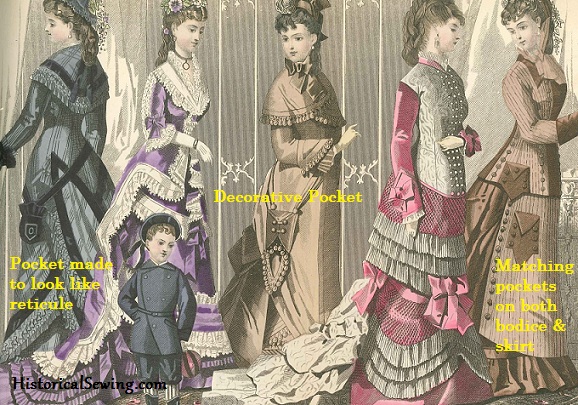
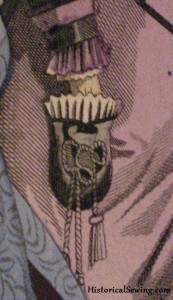
Hidden pockets. Wide pockets. Tiny pockets. Welt pockets. Watch pockets. Patch pockets. Pockets with flaps. Pockets in seams. Decorative pockets and functional pockets. Inside pockets. Breast pockets. Back pockets.
It truly is amazing the variety and locations of pockets in 19th Century clothing!
For easy reference, let’s look at where our ancestors carried personal items in pockets sewn into their garments. Then you can easily add them to your own projects. (Perhaps you’ll remember to actually put them in instead of forgetting like I always seem to do. Doh!)
Regency 1800-1820:
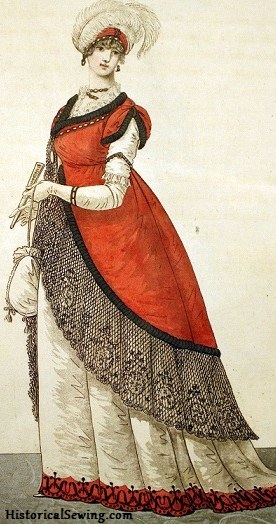
Before the Regency era, personal items were held in pocket bags that were tied underneath the petticoats (skirts) and accessed through slits in the sides. As the dresses in the early 1800s slimmed down, these pockets were no longer hidden. So women carried reticules to hold their personal necessities.
And what woman wouldn’t want a lovely new accessory to show off! The Regency is FILLED with lovely reticules. This is the period solution to carrying your modern cell phone and keys when attending a Jane Austen picnic or ball.
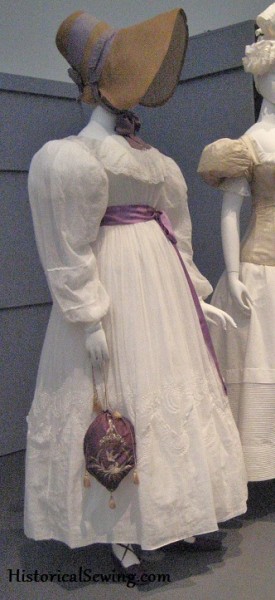
Rarely would you find an attached pocket sewn into a Regency skirt seam. However, examples from existing garments of the era show slits in skirts for access to loose pockets tied around the waist.
Romantic Era 1820-1840:
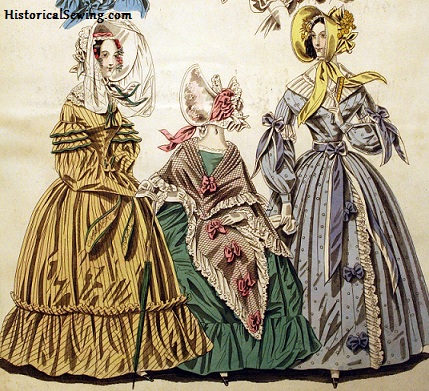
I love this time period! Funky hair, big sleeves, and wide skirts – full enough to disguise the largest of pockets! (I’m sure you could even get away with storing your 10″ iPad in these skirts!)
As women’s skirts became fuller, reticules were still used but hand pockets were added into the side seams of skirts. Openings in the skirt panel, usually on the right side-back area and either in a seam or slit opened and narrow hemmed, allowed for pocket bags to be sewn along the opening or given access to pockets tied around the waist underneath the skirt.
Also, a new addition of a watch pocket is seen on surviving articles later in this period. They are placed at the waistband/skirt seam with access from the outside between the two. Such a brilliant solution so you will always have the time at hand!
Early Victorian/Crinoline Era/Civil War 1840-1870:
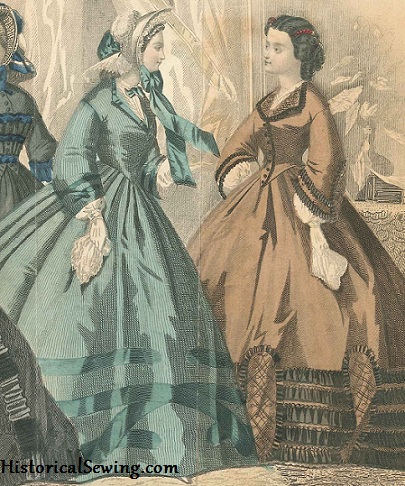
The side pockets, being well hidden in the now extremely full skirts, either on the side or towards the back, became quite large.
The tiny watch pocket was becoming more popular. It was only a couple inches wide and deep and added to the inside of the skirt at the waist. It was set slightly off-center too. I’ve only put in one of these along the off-center opening on my early 1860s dress but it sure is handy!
Pocket Trick: For skirt pockets in your 1860s Civil War clothing, pull from the 18th Century!
- Leave an opening along a side or side back skirt seam at hip level, and narrow hem the seam allowances.
- Cut and sew a 18th C. pocket bag complete with the finished opening (but do not set on a waist tape).
- Align the finished pocket slit underneath the finished opening in the skirt seam and sew together.
- Baste top of pocket to the pleated waist edge of the skirt, and finish the skirt waistband.
The top of the pocket should be long enough to reach all the way up to the waistline of the skirt. Allow for this when drafting or selecting your pocket pattern. Also be mindful that the length of the pocket slit should be the same length as the skirt seam opening and placed accordingly.
Bustle Era 1870-1889:
Ahh… my favorite era to completely forget putting pockets in the skirt.
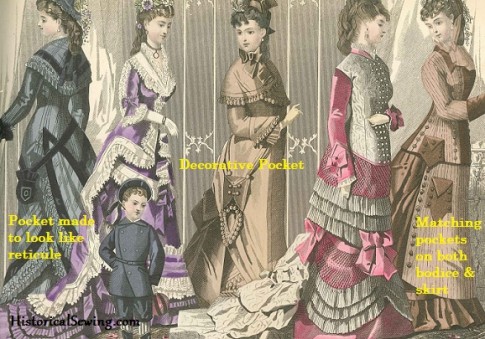
Now that the War was over and sewing machines helped finish dresses in half the time, trims exploded onto gowns – including the popular pocket. Now pockets were seen!
Functional patch pockets and flapped pockets were mounted flat onto skirt panels. You could find them at the side or side back area and also on the lower part of a long basque bodice. Trim was also added to simulate pockets here too. (But we’re only talking about a holding place for your keys and lipstick.
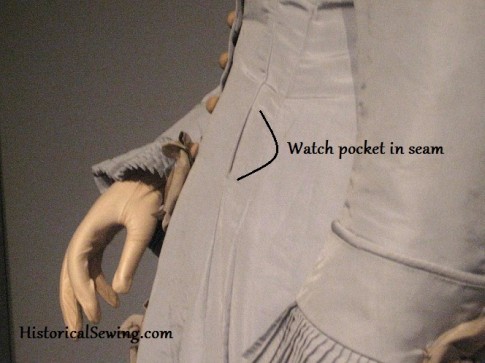
Large hidden pockets were still applied to skirt seams until the late ‘70s Natural Form. This c.1880 dress has a hidden watch pocket along the front princess seam.
In the fitted 1880s dresses with their very slim front, a large pocket with lumpy articles (like keys and a fan) would show through this fitted form. The solution – women simply moved their skirt pockets further to the back – some even into the center back seam. Wouldn’t that would be nice to sit on!
Late Victorian 1890-1900:
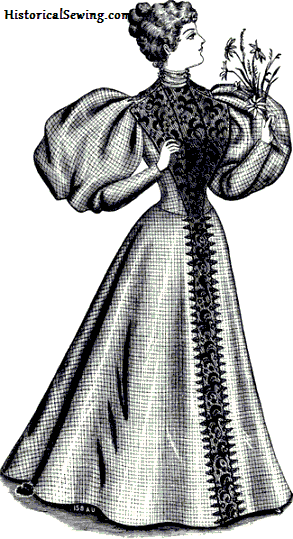
The epitome of Victoriana! 1890s skirt styles were smoothed around multiple petticoats and, depending on the weight of your fabric, skirt side pockets were still found at the side back area and mostly on the right hand side.
Watch pockets at the waistband were still used; however, many existing bodices indicate tiny watch pockets sewn inside the bodice at the center front opening right at bust apex level. These small patches also show up on the outside of the bodices at bust level. (What a strange place but they did it!)
Of course, even though you see pockets sewn into clothing throughout most of the century, reticules, bags and purses were carried quite often.
Though, instead of juggling a reticule with a parasol, fan, dance card, camera and champagne glass, simply put a large pocket into your skirt side seam and stash away those modern items. It’s a nice modern solution that’s period correct as well!
Where are your functional pockets located in your period clothing? Do you remember to add them when you’re making the costume?
I’m thinking about sewing my reticule right onto the side of the dress. Is this ever done?
Then it becomes a patch pocket which are only seen briefly in the 1870s – and even then are not necessarily functional but more decorative elements. Of course, outer pockets are seen much more by the time we get to the later 19-Teens and then more mid-20th Century and beyond. But a patch pocket is not seen much on dresses in the 19th century. An apron is a better use for this pocket and IS seen with patch pockets all throughout the century.
I always have to do a welt pocket on my bodice, always on the right hand side. I stole it from a man’s vest pattern from the period. It is marked with a medic alert fob for my epi pen. A second pocket is generally sewn from the waist of the foundation skirt to hold cell phone, id and inhalers. Those are my “nevwr, ever leave home without” items. Along with a card listing Dr and husband’s phone numbers.
The people in our group all know that the epi is always in that spot. We have great friends who have taken the training that lets me actually go to teas and other events, even if my husband is busy elsewhere.
And a police friend has told me to Always make sure your id is on your body. ‘Cause you just never know.
At least if you forget them, you can always add them after the fact …and no sewing needed 😉 And move them from outfit to outfit, too. Google ‘PortaPocket’ and see what I mean…it’s your pocketsRx solution. Help yourself! :))
I have a dress and three petticoat from my great-great aunt. Silk taffeta, embroidered net yoke, the works. It was daunting atfirst to determine which was the skirt and which were the p etticoats since they are all beautiful. One clue was in the volume of fabric because the skirt had to fall gracefully over them all. Another clue came from discovering how she lived. Aunt Alice bartered her eggs and woven rag rugs in town on her shopping day. She carried her cash money in a pocket in the petticoat next under her skirt. If she wanted something badly enough to spend cash for it she would have to raise her skirt to get her money. She purposely did not leave an access slit in her skirts. Frugality and modesty kept her from being a spendthrift.
Great story!
I wondered where they out the pockets in natural form dresses.
Why do I now have a crazy idea for a handbag disguised as a bustle? lol!
I suppose you could also hide pockets in those apron like draperies too?
Purses were becoming popular with these slim gowns, but they still had waistline pockets for watches and a few skirts had seam pockets. However, with the slimmer the skirts the less likely you’ll find large pockets in them.
I love pockets. The bigger and deeper the better. I have a reticule that was made to match my dresses and instead of carrying it I will pin it to my waistband to carry the Smalls.
Pockets rule!
There was an exhibition about Pockets 16th-21th cent. at the Bavarian national Museum Munich these days.
You can get a catalogue/brochure if you are interested in, there are many good detail pictured….
http://www.bayerisches-nationalmuseum.de
I HATE carrying things when I go to events. As a result I never make a costume that doesn’t have at least one big pocket somewhere in the skirt. I’m a great fan of side seam pockets on farthingale and crinoline skirts. If there’s a gapping issue I either velcro it or use tiny hooks and crocheted eyes.
I’m also a fan of hanging stuff on my costume if at all practical. One way is to sew a small “D” ring on the inside of the bodice just high enough that it isn’t visible. I like to put it on the boning channel so it doesn’t pull the bodice out of shape. If anyone is ill-mannered enough to comment I tell them about a photo I have of my great-great grandmother wearing her fan dangling from a ribbon on her waist. There’s also one I’ve seen of a lady with a bunch of keys tied to her waistband. So it may or may not have been done in the U.S., but it was done in Germany.
Those are both perfectly sensible things to do; plenty of people wore Chatelaines, for hundreds of years up into the early 20th century. We have countless extant articles from various eras, some of which are incredibly elaborate and could easily have cost a literal fortune, and others which are incredibly simple and could be made by the average working-class woman.
Essentially, they were composed of a central piece which was either permanently attached to a decorative belt, or could be pinned to the waistband of whatever you were wearing; from that, items dangled on chain or ribbon, and commonly included
-a tiny pencil and pad of paper
-a little coin-case or purse
-sewing accoutrements
-keys
-bottles of perfume
-card-cases
-magnifying glasses
-a pocketwatch
-spectacles
-a wine bottle-opener
-a mirror
-a manicure kit in a case
….and so many more! Basically anything you can think of attaching to a chain dangling down the front of your skirt exists out there somewhere. Some had purely-decorative components dangling, too, and the largest chatelaines could have several tiers with some twenty (or maybe more!) items attached, though most seem to fall between 3 and 7, depending on the needs of the wearer.
It seems you posted this comment several years back, and in all likelihood you’ve encountered this information already; but I know I read the comments on articles, and a reply, however tardy, may help someone else reading the article now or in the future. Pockets are awesome, and were totally a thing, but there are other HA options available that may suit things like slim Natural Form dresses better. I hate carrying things like purses and reticules, too, so any chance I have to attach the things to myself is a welcome one, pockets or no pockets!
those huge sleeves from the 1830’s and 1890’s all call out to me to put a “secret” pocket in their seams too! All that Poof can concele a pretty good size stash.
I’d just leave a small access in the inner seam line add some velcro to keep it shut and stash my room card/key,lipstick and CC’s in there. No pocket lumps to ruin the shirt line.
Just had an aha moment with this entry. I’m making an 1878 outfit for a lady photographer and will be carrying an antique camera and “taking photos”. I planned to hand out preprinted photos to people but had no idea where to carry them. THIS is perfect,and the right time period! Thank you Jennifer!
This is my first attempt at a gown that I’m sewing for Dickens on the Strand in December (I figured I’d need loads of time to do all the underpinnings, et cetera!). Anyway, I’ve been agonizing over things like where to carry those pesky little modern items such as camera, iPhone, keys, and so on, and then I thought, what about little details such as driving a car or using a port-a-potty at the event! Yikes! I’m visualizing myself struggling with a hoop, dumping things out of my pocket, not being able to close the door of the ‘privy’, and whatnot! And don’t get me started on calling the fire department to use the jaws of life to pry me out of my car when I arrive at my destination in a hoop. While I would love to have the experience of wearing a hoop, alas my transportation limitations and living so far from the event probably will have me wearing a mass of petticoats and sewing many secret and heavy-duty pockets into my gown… What are your thoughts? What do the ladies usually do in these ‘modern’ situations?
Hi Judy,
Yay for starting early on your gown! You will have fun and learn lots.
Have you read this article? https://historicalsewing.com/what-everyone-ought-to-know-about-wearing-a-victorian-corset Lots of tips for how to move in a corset but also when you have layers of petticoats, hoop & skirts on. 🙂
Jennifer
Judy, I’ve worn a farthingale before–an Elizabethan hoop skirt–and what I did was make it with a drawstring waistband. Then I put on JUST my undergarments, aside from the farthingale, and drove the 2 hours to the Ren Faire. In the parking lot, I put on the fatrhingale, petticoats, skirts, and bodice–all carefully laid in the trink in the right order to put them on quickly. I had a friend to help, but I actually wound up not needing her other than to tell me that yep, everything was on straight. It took me all of about ten minutes at the back of the car to accomplish this.
Also, if you’re concerned about dumping things out of your pocket, use a tiny scrap of Velcro–not period, I know, but if you have it hidden, no one will ever know. And if you go, “but *I* would know!” (which I admit to doing), you could always use a hook and bar, which would be less convenient but still openable. Generally, though, as long as you make your pockets deep enough to hold what you want them to hold, youll be fine. So test that out in your muslin stage! Make pocket, toss stuff in, see how it strains. I usually make sure I’ve got enough space for my stuff and half my hand, too, for each pocket.
I worked for the Texas Renaissance Festival for 20 years, 10 in the Performance Company. I also learned that dressing from the trunk of your car was the easiest way to go. I built all my costumes with the intent of getting into and out of them on my own. I wish I could do that with my 19th century garb.
Check this out… it appears to be a small pocket hidden under a flap at bust level on the left hand side of the bodice. http://www.metmuseum.org/collections/search-the-collections/80036161?img=5
There’s another one here- http://www.metmuseum.org/collections/search-the-collections/80036269?img=4
They may be something else entirely, but since I can’t think of a single other purpose for them, I’m assuming they’re pockets!
Actually, my guess would be that those are for breastfeeding. Very cool that you found them & shared. Thanks!
I have a pocket in the seam of my Victorian dress for more necessary items, and another hidden under the bustle ruffles for less immediately-necessary items!
I sew pockets into absolutely all of my Hoop Era dresses (well, except for sheers…) I love them, and they are just so darn handy! I often carry little reticules around as well to accessorize, but there’s nothing for carrying around your indispensable items like a trusty pocket in your skirt 🙂
I might make a pare of 18th C. pockets to go under my regency bib fronted day dress.
That actually works – I’ve done it out of frustration. As long as you don’t care that your silhouette isn’t exactly maravilleaux!
I’ll need to remember this page when I make my next dress! I’ve just finished my first period style ball gown (or any gown, really) and I made a reticule to match. But POCKETS! Next time, I’ll try to remember! Also, I need to go to your facebook page to share my ‘first ballgown’ pictures! 🙂