
You’re standing under the two foot square of shade under the tree, fanning yourself as fast as possible. The cool air you crave is elusive….
Twirling around and around, you laugh and collide with fellow dancers on the packed floor….
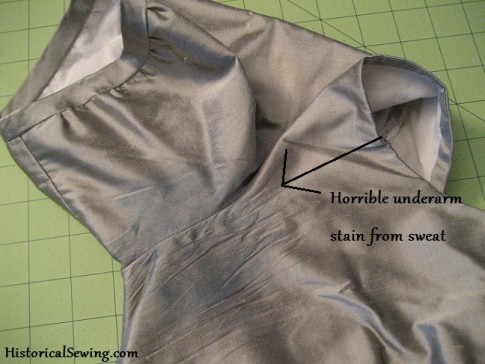
If you do any sort of costume events in warm weather or in a ballroom, you know how hot you get in your dress. Then the inevitable occurs – damp sweat marks start to form under your arms, spreading over the sleeve and bodice.
Don’t let this happen to you! Take up your shields!
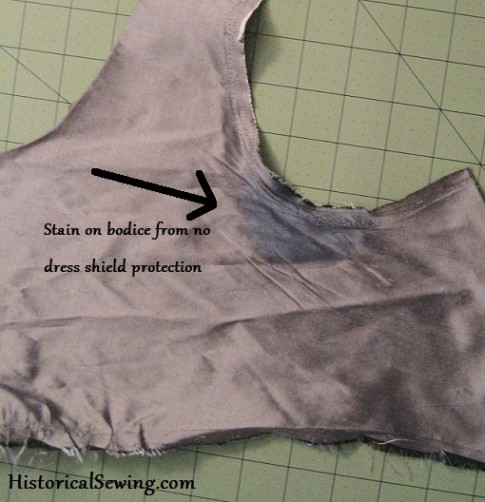
Have you ever ruined a bodice with sweat stains? Areas that just couldn’t come clean?
The best (and period correct) solution is to put in dress shields. These half-moon, oval shaped pieces made of two or more layers help absorb perspiration and keep your dress dry. Well… they at least are a HUGE help in keeping your bodice as dry as possible.
Although I wear dress shields in nearly all my costumes, I “glow” profusely and end up with damp underarms anyway. This is ok as I assume I’m probably not the only one who’s warm and if I remember to keep my arms down for photos.
But I wouldn’t dress up without them. Even when I KNOW my armpits will rebel against my proper Victorian nature. Even with doubling up on the shields it still is no good. (Perhaps you have better luck…)
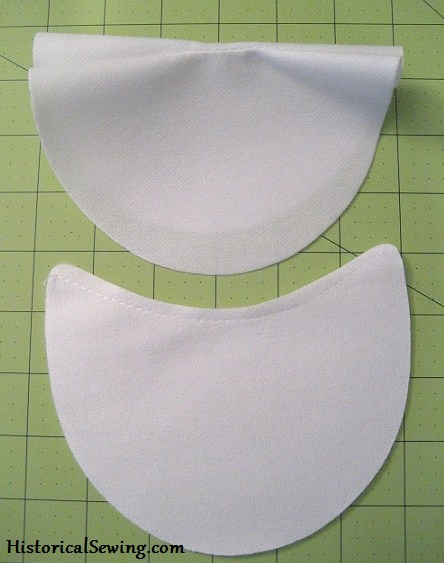
My favorite dress shield supplier Greenberg & Hammer went out of business in 2010. But lately I’ve had good luck with the basic Dritz ones I can pick up in my favorite chain fabric store.
Generally modern, pre-made dress shields are made from an ultra-absorbent or wicking fabric. I used to have a pair that had a plastic type of inside that worked really well – that is until I forgot to remove them and they got run through the dry cleaner.
(Note to self: remove dress shields before taking to the cleaners!)
If you don’t want to spend the few dollars for pre-made ones, do what our ancestors did – make your own!
- Use a couple layers of strong muslin with a thin cotton flannel in-between. The flannel is more absorbent. You could even use birdseye diaper cloth in the middle.
- Trace your bodice armhole seamline from a couple inches toward the back of the side seam and about 3″ (or more) towards the front. You can adjust this depending on how your bodice fits. My shields are always tilted more towards the front for better protection.
- Draw a half-oval shape 3″ to 4″ or more deep and add seam allowance to the armhole edge.
- You’ll want to cut 4 half ovals (= one shield). Two ovals will be together on the bodice and the other two layers inside the sleeve. Seam them together at the armhole line. Finish the seam and raw edges with pinking, zig-zag or serging.
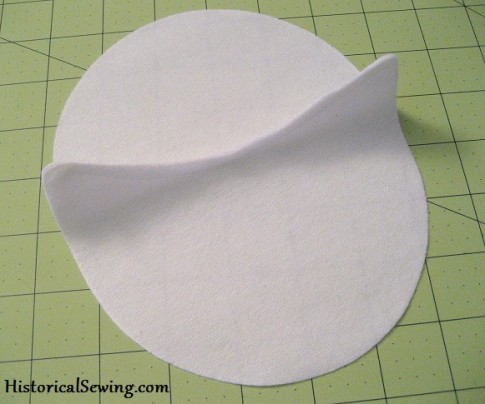
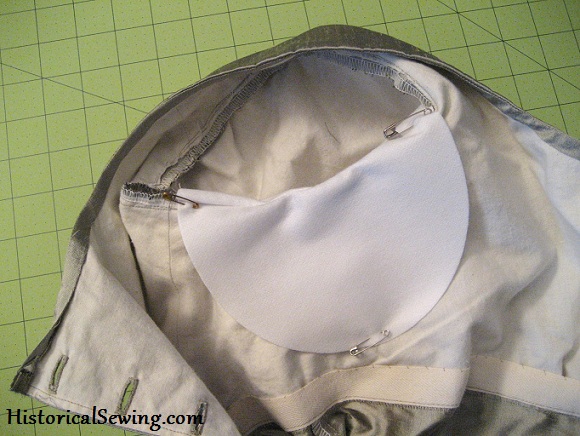
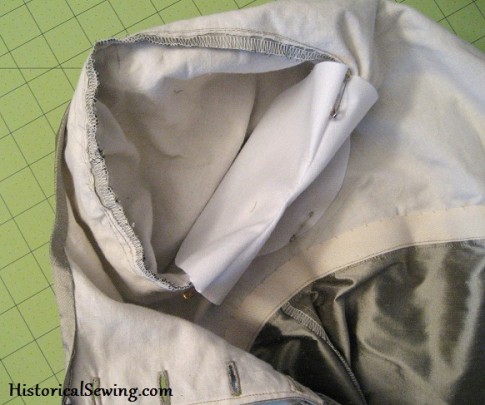
To wear, I recommend using tiny safety pins at the seam corners and at least one at the bottom of each oval. You’ll want to put the shield seam along the bodice armhole seam with one oval lying flat on the bodice and the other half tucked down into the sleeve.
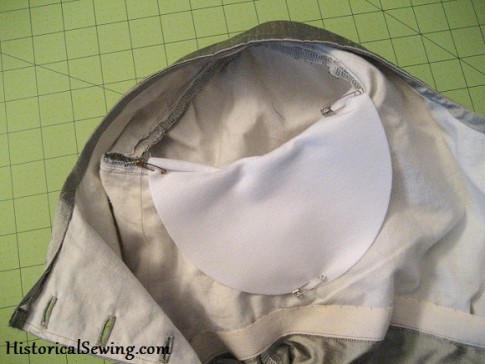
Pin the edges down by only picking up the underlining of the bodice. If you have sheer sleeves with no underlining or lining, pick up a tiny amount of the fabric. If you have bodice seam allowances nearby, pin to them.
Even with good dress shield protection I will always do a quick cool water rinse of the underarm area after wearing to remove the chemicals of my deodorant and to dilute the perspiration on the garment. (I even do this (very carefully) with my silks and haven’t had too many issues.)
So Remember to Arm Yourselves Maidens! And please share this article (aka Share, Like & Email) with other damsels who need protection.
I have been putting shields to protect my favorite nightgowns. I put far too much work and money into treating myself to lovely fabric to make my nightgowns, but the stains in the armpits annoys me. Even though I launder my gowns, they still get stains. I don’t want to have pins, and snaps are a challenge because they can dig into your skin during sleep. So I decided to make a system of loops through which I tie ribbons. I just add very small loops (I have had the best luck using narrow flat elastic to make the loops, it allows a tiny bit of extra give, which is helpful) in the armscythe, I add a bit of extra to the front and back seam allowance, when cutting the fabric out, but even without that it works fine to just add tiny loops to the seam allowance. Then just add a small ribbon to the points of the shield so you can run the ribbon through the loops and tie a bow to secure the shield to the garment. Just make sure you are tying a secure bow (check out YouTube for some instructions to tie a bow that is secure). It is secure and gentle and no worries about getting scratched by buttons or snaps or stabbed by a safety pin coming open. Cheers!
What a great idea to protect those lovely nightgowns! I’ve wondered the same thing even about chemises. So much work and they get all stained (which is what they are supposed to protect the gown from). Thanks for the loop and tie idea!
I was looking at some 18th C corsets made by Lauren, CEO of American Duchess. She made sweat protectors out of very thin leather on her corsets. It’s accurate & fixes the problem of yellowing. However, these are work a day garments. They get old & worn. But, wearing a lovely linen shift/chemise underneath is vital to comfort.
Every time I hear some actress go off on how uncomfy their stays are, I want to scream. If it’s properly fitted, it will be comfortable!
Lauren’s leather pads on her stays look amazing! Plus, they are seen on originals. I’ve not seen the same leather patches on 19th century corsets though. Perhaps they were better at adding dress shields to their dresses.
And yes! to properly fitted corsets! 🙂
I wonder if they were put on lower class 19th century corsets and just haven’t survived due to survival bias!
I have a pair of original dress shields, which are filled with lavender. Or, not “filled” anymore because the plant pieces have dried out and broken up into a puddle at the bottoms. These particular shields are made of silk.
Ooh, that’s cool! And a great idea for new ones we make.
If prevention fails and you need to remove sweat stains, try hydrogen peroxide. I apply it straight from the bottle and let it sit on the stain for a little while, then a long soak it in cool water and more peroxide, followed by a cool water rinse. Repeat as needed until the stain fades. With patience and persistence you can usually get out even the awful yellow stains deodorant causes.
The usual disclaimers apply: colorfast fabrics and testing on an unobtrusive spot first, but I’ve used this method even on delicate silks without harming the fabric and saved several garments. (It works for blood too, just FYI. I learned the trick from a paramedic friend.)
I might have missed something here, but how would this work with a sleeveless gown?
You would have to make the dress shield for only the area of the bodice which would be half size of this full one. Or take a two-part shield and simply fold at the seam and pin in.
I had some wonderful reusable breast shields when I was nursing; they had a layer that wouldn’t let moisture through but was breathable. They would be too small, though. However-my son had a nasty dust mite allergy when he was young, so I needed to cover his mattress to keep him from reacting. I found a mattress cover at Target that resembled the outer layer in the shields–it was breathable but waterproof(and, naturally, dust-mite-proof) and washable. Maybe a layer of that in the dress shield would keep moisture from getting through. They were very inexpensive, and you could get a WHOLE LOT of dress shields from one twin mattress cover. Or even a crib mattress cover, for that matter.
Along the lines of the disposable breastfeeding pads… I used some lovely felted wool ones when I was nursing–so much more comfortable and absorbent than those icky paper and plastic things. I wonder if dress shields in the day would have been made with layers of fine wool cloth, perhaps flannel.
We used to used this amazing trick all the time when I work in the theatre and the costumes couldn’t be washed until the end of the run. Each actress would be given a colour and we would tack a few stitches onto each shield so when they came out the wash we knew who’s gown to put each back onto. Each shield would be attached with the tiny sized snaps/poppers you get and the other half sewn into the seam allowance of the dress so at the end of a show we had the delightful task of dashing round and whipping out all the sodden dress shield to get them in the wash and putting them back in in the morning. Its did help a lot at keeping the dresses vaguely fresh and made the girls feel a lot better. I use them on all my gowns now.
Hmm, I wonder if disposable breast feeeding sheilds would work. They usually have a leak proof inner layer to protect against “leakage” they also sell washable ones premade.
What do you do for sleeveless bodices?
@Hazel Yes! This is an option! I just found this video from Kleinerts (dress shield specialists since forever) that models a snap-in version. It would be really easy to make Jennifer’s shields above and just add snap tapes like the ones shown in the video. That’s what I’m planning. I love the idea of washable AND no pins or sewing for everyday wear. I don’t want to suddenly get poked in the pit by a slipped safety pin! Eek! 🙂 Thanks so much, Jennifer, for the easy directions!
If you don’t want to be poked–which I can fully understand–take a couple of hand tacking stitches. You can pull them out fairly easily later, and no worries about slipping! Personally, I really don’t like the idea of snaps because I feel like THOSE would rub and irritate, too, so basting or tacking with thread is really the only option I can consider. Sure, it might take me an extra thirty seconds or to so get the stitches out at the three or four attachment points, but I’ll have reliability and comfort the whole day/night beforehand. It’s a fine trade-off.
*heads off to see if she can’t find the PUL fabric and make a couple pairs of these things for use in her good suit, much less costumes!*
what about making dress shields that you can snap or otherwise attach to your bra, beneath your arm? Is this an option?
I suppose you could do this and attach to the bra, but the point of dress shields is to protect the garment. Not sure if attaching to a bra will absorb the sweat enough to protect the dress. You might be disappointed.
So does this mean that other ladies are wearing modern bras with their historical dresses? I thought I was being a traitor to accuracy for not abandoning my padded push-ups when I go otherwise fully 19th century! A good corset can only do so much to give you an hourglass figure when there’s nothing in the top half of the hourglass. 😉
I have found a wonderful way to keep perspiration stains off of my clothing. There is a product called PUL. I find it at JoAnn’s and probably in other fabric stores as well. It is actually meant for the outside of “home made fabric diapers” and stops anything!
If you cut your shield out of fabric (2-front and back) the sandwich a piece of the PUL inside of the fabric, it will not leak at all. I can even use terrycloth on the inside of the shield or Birdseye diaper fabric for a soft, absorbant fabric next to my body. They rinse out wonderfully and you can make them as large or small as you wish.
Jennifer,
do you have a recipe for the vodka spray or is there somewhere we can purchase the vodka spray?
There’s no recipe. You want to use the cheapest vodka, like bottom shelf, store brand, you can find. (Don’t even try to drink it!) The proportions vary as to what kind of fabric you’re spraying it on. You can use full strength on stronger, light-colored fabrics like linen & cotton all the way to just a tablespoon or two in a bottle for silk. I generally just pour in a small amount in a spray bottle with some water for freshening. To remove stronger odors, go for at least 2:1 water to vodka or more. I usually just wing it and haven’t had any issues (even with silk). But someone might have more definite figures.
I have used panty shields in the past with success. The ones with the “wings” work even better.
That’s genius!
What about protecting corsets? Mine have very attractive slightly yellow patches at the underarms. At least my white wedding corset dose.
I have the same issue on my well-worn corsets, even with always wearing a chemise. Make sure to use a vodka spray as soon as you take it off so the vodka will eat away at the perspiration and keep it clean. You could make some thin shields and pin over the underarm area of the corset too if you’re really worried.