
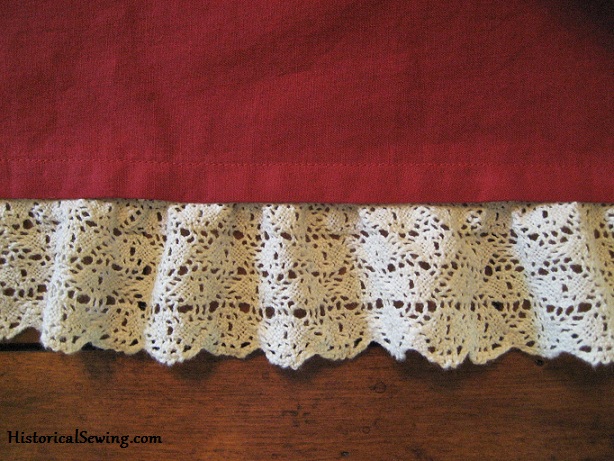
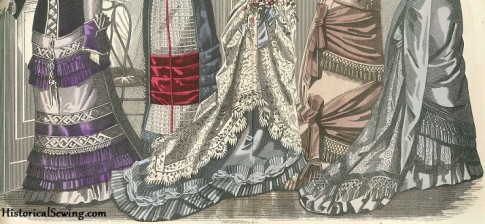
A certain look is produced when trim, such as lace, fringe or a ruffle, is tacked to the hem of a skirt. The basic thought is to first finish the hem (by hand or machine). Then sew on the lace on top.
I did this method for many years and many costumes. But then I questioned how it would look if I sewed it to the wrong side of the hem. The first time I tried that – whoa! What a period looking dress I had!
Sewing that trim to the backside can give it a more couture and historical look. Here’s a look at what both methods produce and why you might want to turn your skirt around to sew.
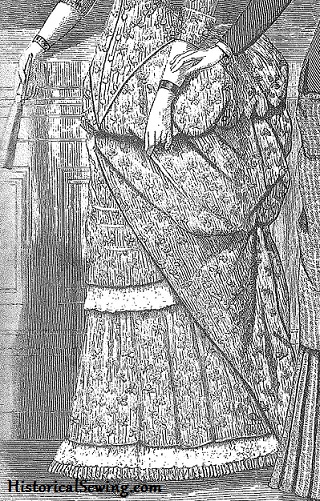
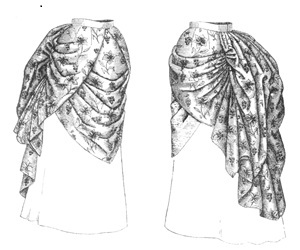
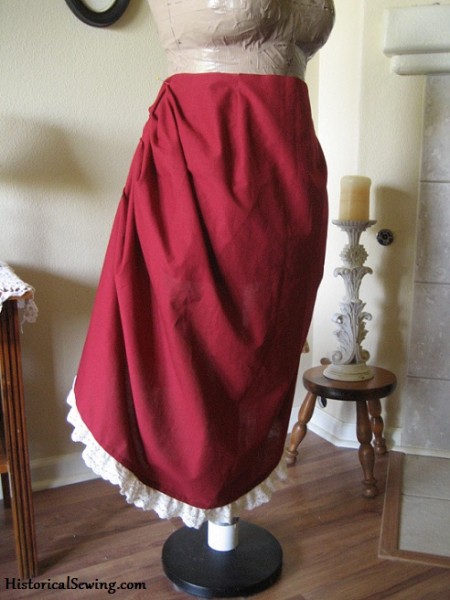
Currently I’m making an 1883 bustle day dress. My inspiration comes from a February 1883 Harper’s Bazar fashion plate and using the Truly Victorian 1884 Wash Overskirt pattern.
By studying the plate I can see that the lace appears to stick out from BEHIND the apron. I wanted that in my reproduction too. So I then realized that the trim would need to be sewn either to the back of the apron or even to the skirt foundation where the apron would hang over it (dumb idea. Don’t try it).
My lace is 2 ¾” wide cotton crochet. My apron a lightweight cotton solid. I followed the pattern and made a ½” double hem with the one inch allowance given. Make sure to press your hem good & smooth!
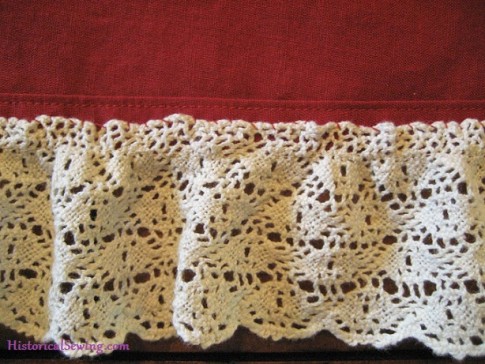
The lace was flat and in a slight curve but I ended up running it through my gathering foot. I pinned it about halfway into the hem allowance – so about ¼” of it was on the inside. It’s whipstitched on through the hem allowance. Man, I sewed it on tight!
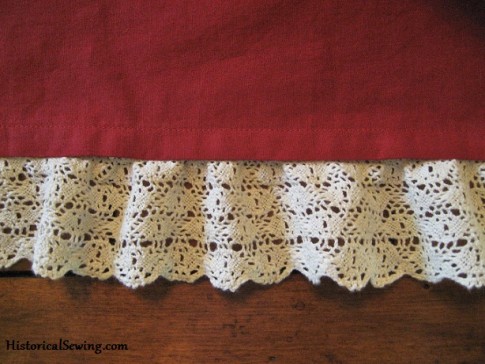
Ta-Da! Look at that beautiful edge. The hem seems to float over the lace. It creates a little lip to cover the top of the lace. The smooth hem stitches show and that’s ok. You can also cover them up with a bit of ribbon. It’s Victorian – the more trim the merrier!
If you sew the lace directly to the top side, it’ll stick out a bit weird. It may give off a more costume-y look than you’d like. Look at the above photo again of the whipstitched lace. Imagine that was the top side. See how it lays in a strange way? That is the 9th Grade Home Ec Class way of sewing, and it’s not always the best way to do historical costuming.
Have you sewn trim the wrong sides of hems? What did you think about the results?
Is it just me, or does the right-most dress in the top image look a lot like the 1880 silver-blue gown from the LACMA 2011 museum display? down to the fringe trimming the overskirt. That’s like finding a fashion plate that looks just like Great-grandma’s wedding dress! 😀 Too funny!
Love this tip! My next project wasn’t going to have any lace, but I’m thinking some of the pleats might get sewn to the back of the fabric in this way (it would certainly take off the pressure to have the header looking perfect, lol).
Just for info, the lovely lace isn’t crochet, but torchon. Many manufacturers get the two mixed up and mislabel their wares, but the woven diamonds (or “spiders” or “eyes”) are the giveaway. By the Bustle Era, lace like this could be machine-made, making it far more affordable than fifty years earlier. The bars between the spiders resemble crochet, but are more braided vs crochet’s loops. Crocheted lace was often a homemade alternative to buying or making torchon lace, because all it required was thread and a fine steel hook…and many, many, many hours with nothing else to do 🙂
Thank you so much for this.I am about making a dress with fringe at the hem.
I recently read “Authentic Victorian Dressmaking Techniques” which is text and figures (illustrations) that were originally published in 1905 by Butterick. There’s a great deal of discussion of hems, but one method surprised me. To add a ruffle to a finished hem, they said to cut open the very bottom edge of the fabric, lay the right side of the ruffle to the right side of the hem and stitch with a 1/4 inch allowance to the outside layer of the hem only. The raw edge of hem on the wrong side of the old hem is then turned up so there is no raw edge showing, and stitched. Basically, the raw edges are turned up toward each other with the ruffle sandwiched between.
So instead of ripping out a great lot of stitches, all you need to do is cut carefully! Though I think this would work best with a short ruffle; you might not want to change the length of the garment piece too much.
That’s a great book! This hem method is one for heirloom sewing and very much used in the Edwardian era. 🙂
Nice! Can I use the zig zag stitch for a stretch polyester skirt and stiff Venice lace?
This article just gave me an idea to add a lilac colored lace trim to the bottom of my thrift store cotton white eyelet and embroidered skirt. I recently added a white ruffle to the bottom (mostly because it wasn’t long enough) and this would be a lovely touch of color to the bottom which I’ll use as my accent color for a summer Sunday afternoon promenade by the sea. I’ve just started sewing, after researching historical sewing. Now I’ve got a new hobby! I’m also looking for another evening dress to wear for the same event in Nahant, Mass this August. Thank you Jennifer!
Yay! Have fun Claire!
I thought this was how it was ‘supposed’ to be done – I mean, I know in clothing design and construction you can break almost any rule for good effect, but this just seemed obvious to me. Unless the trim had a notably decorative upper edge, or I was attaching ruffle slightly below its top edge so there would be a little bit of ruffle above and a lot below the line of stitching, I almost always attatch trim to the back of a hem or into a tuck. I like how, if the trim is long enough, it can create the illusion of a whole additional layer to the skirt.
It’s quite a modern thing to just slap trim on top of a garment. Heavily promoted by the Big 3 companies in their sewing instructions and designs. Trim on the back looks so much better! And yes, can all the illusion of more depth.
I have done this by machine (yes, euuuuw!) but kind of in a reverse order:
First I used my serger to finish off the hemline and folded it up, using an iron. Then I pinned the lace about 1/2 a centimetre from the fold on the right side, going “up” over the skirt (as in not hanging down). I fastened it with my machine and then i did the last hem fold, ironing it in place. Now the lace pointed Down as it should and was hidden behind the fabric/being on the inside and I could finish the hem stitch. Hopw this makes any sense, but it was a lot quicker than going by hand!
You get a similar effect when sewing lace or whatever on the skirt somewhere above the hem if you put a tuck in the skirt and then sew the lace/whatever inside the tuck. It looks very period.
Do you think this technique was a great way to preserve lace too?
Preserve in what way? It would definitely take less wear being on the back side – no rubbing from brushing up against other people and things. It’s hand sewn on too which does make for easier removal.
I was thinking it since people were known to re-used fabric and re-styled clothing, instead of constantly buying new ones.
Then it would be a good way to preserve the lace or trim (handmade or machine) from daily wear & tear. I like the technique and it just seemed to me if as they were thinking ahead about their clothes.
I have a BEAUTIFUL aqua and buttercream bustled ball gown planned to have gold trim and a cream draped apron with lace along the edge (sounds lovely, no?) I have been struggling over how to attach all the trimmings for this gown and also my Christmas Afternoon gown I have planned. You SAVED MY PROJECTS!!! Thank you SO much! I will certainly try this (now obvious) superior way of adding lace
I am looking forward to seeing your finished product. I bought Heathers pattern also and am using some vintage lace from my great grandmothers trunk.
Hmm. I usually add the trim with a facing on the inside. It looks different from either of the two options you describe, but is perhaps too flat looking. I have hemstitched lace onto handkerchiefs, too. I think hemstitching an overskirt would be overkill, and lack accuracy too. (Sorry, could not resist.)
I like that! Very nice. I could see this technique use elsewhere as well, maybe to dress up a top or even a plain tank top. What a difference it makes, pinning to the back. I haven’t tried making a Victorian costume yet, but it’s on my wish list. I made a Ren Fest costume YEARS ago, and that was pretty satisfying. Thanks for the tip!
You’re right, Juli, this method could be used lots of places. It really can make a difference in the look.