
You know the routine – you didn’t allow enough time to finish your dress and now you’re having to cut corners to get it even *wearable.*
I’ve been there. Early on in my costume sewing. Not so bad that I had to be sewn into my dress, but still pushing the clock til it was bruised. I have, however, sewn friends into their bodices. Not something I like or want to repeat.
So I began to notice little areas I could… shall we say… cheat a little in my projects.
I mean, I’m a modern 21st Century girl with a full-time office job, a husband and two furry, attention-deprived (apparently) kitties. Oh, and a house to maintain, extended family to spend time with, a blog to write…. you get the picture. I’m sure you’ve got a long list of responsibilities too.
So while I was balancing all my twirling plates I’d find ways to make my sewing MOVE faster. It’s so annoying to spend an entire Saturday afternoon on pattern alterations only to fall into bed that night cursing the heavens for the speedy passage of time and your inability to get things done quickly.
I have to warn you here, especially if you are a hard core/purist/authentic sewer. I cheat. I use modern methods for my period garments. 99% of them.
In no particular order…
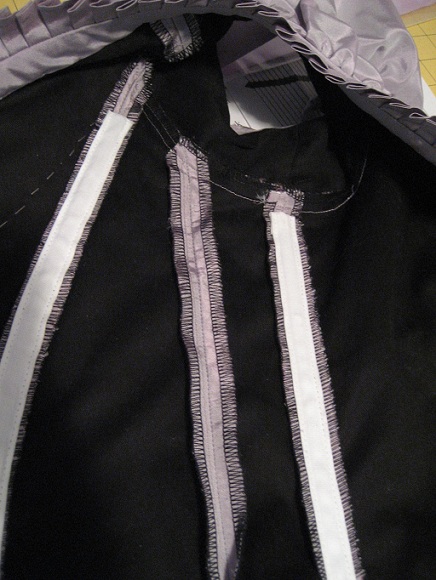
*I serge. Everywhere. Nearly all my seam allowances are covered with those fancy loopy stitches from my Viking 936. I flatline this way. On some edges though, I’ll have to machine baste, like on necklines and hems that will be enclosed in bias. The last thing I serge on my bodices are the armhole seam allowances.
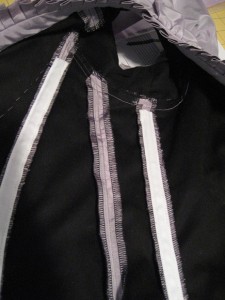
*I use modern interfacing in belts, collars, cuffs and along the back buttonhole openings on Regency gowns. I don’t do this all the time. But when the stash of organdy has run out, well, my hat box full of fusible interfacings will produce something that will work.
*The Assembly Line. Yes, it really does work, and fast!
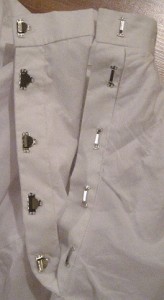
*The closets full of historical clothing would not be possible without skirt hooks & bars. I should buy stock in Dritz. 56% of my openings are closed with skirt hooks. The other portion with buttons and (machine-made) buttonholes with 7% regular hooks & eyes or thread loops. (75% of statistics are made up on the spot but not my use of these fabulous little notions.)
*Rotary cutters were made for making bias for piping and finishing. I seriously don’t know how the Victorians lived without them.
*”Petticoat ruffles only take 27 hours now and not the grueling 68 it used to take with the new Ruffler foot!” Get it today to speedily set on miles of gorgeous, flittering waves of cotton. My eyes were opened with this. No more two basting stitches, sewing over dental floss or the like. Although on a side note, I still do prefer the look of regular two thread gathering and use it often. Just not on petticoat ruffles that no one sees.
*I use Stitch Witchery, Fray-Check and Fabri-Tac glue.
*Washable fabrics get pre-treated in a washing machine and dryer.
*I apply my boning in its casing to the bodice by machine. (The only part I hand whip is on the dart points.)
*And I use a Sharpie to write sizes on the ends of bones and rows of cut hoop wire.
Of course other modern methods pop up as I’m going along as they usually do. I’m a rogue.
Now that you know some of my 21st C. secrets, please share yours. I know you have them too. 🙂
I Understand trying to be HA. But if it isn’t going to show, what does it matter? Like serging all your raw edges first. That is a great idea, and one that I’m sure they would have done if they could have. I will keep these ideas in my mind for my next project.
We need people deeply interested in historical clothing construction to continue to research for posterity. For casual costumers we decide how into historical methods we go – some try to be as close as possible for their own interest and research, others of us simply want the end result or are fine with “cheating” as it relates to our own creativity.
And there’s two sides to the thought about sergers (or other modern tools/techniques for sewing): 1) They didn’t have XYZ so I’m not going to use one, and 2) If they had XYZ they would have used it. I think we simply need to encourage sewing and creation of projects rather than say it “has to be HA” or “let’s use modern methods”. Which, BTW, serging is awesome for raw edges! 😉
When you’re using your ruffler (or a serger) how do you make sure that the length of the ruffle is matching the length of where you’re attaching it too.
There’s lots of videos on YouTube that show ruffling, but never the full attachment on a gown. 🙂
I’ve never used a ruffler on a serger before. (Is that even available??) Also, I’ve not ever ruffled and sewn to a flat piece at the same time as I’m particular on how it looks. Not just that, but with historical sewing it’s not as easy as modern projects to calculate ruffle lengths and have the ruffler sew exactly matching to the length needed on the garment. The ruffle projects are MUCH bigger and longer. And generally, ruffles are mounted on top of garment panels and not necessarily matched to a straight edge as rufflers were designed to handle on modern projects where a ruffle is sewn into a seam allowance.
That said, rufflers can be adjusted to various ratios. I keep mine on the “6” which gives about a 2:1 ratio.
I am trying to make the look of the Victorian entranceway that many times had a macrame swag. Can you help me cheat on that? It’s for a production of “Arsenic and Old Lace”. Any help will be welcomed. Sometimes they were made of wood. A cardboard one is possible, too.
Are you talking about spindle work and moulding? Maybe dowels and wooden beads painted.
Im going to my first reenactment (Civil War) and working on a camp dress a day dress and a ballgown for the event. Luckily the camp dress and ballgown are being borrowed amd I’m only doing alterations. The day dress, however, will be new . (and underpinnings)
Thank you for your helpful videos such as how to sit in a hoopskirt.
My friend has been a reenactor for nearly a decade and says she is NOT Farby (yes, I had to look that up) and not a “Stitch Counter”… but somewhere in between.
After pinning 20 million knife pleats the last week and creating my own ribbon rosettes & ribbon roses for the ballgown overskirt, and reading about how quickly women in the 1860s adopted the use of sewing machines and rubber soles for their slippers, I’m absolutely certain that they would have used an automatically gathering presserfoot, sergers, modern interfacing and any other timesaving devices we have now.
I’m sure if an 1860s woman made her way to today via time machine and saw todays sutlers counting every hand stitch and avoiding using the conveniences we have today, she would shake her head and wonder why they waste so much of their days basting &gathering when a simple device could save them so much time.
Horray for your embracing fray check.
Ps… I mistakenly bought wired satin ribbon to make my rosettes with and I’m so glad I did… it was so much faster to just scootch the ribbon together on the wire and tie the ends I pulled out into a knot & cut them off then baste the ends of the ribbon together to.make the circles…and yes.. I definitely used fabric glue on the raw edges so the satin would not unweave itself into a frayed mess… certainly a timesaver… and Noone will.ever know except me….well… and whomever reads this.
Our ancestors were making their clothes – items they wore on a regular basis. We want to reproduce them *perfectly* but we’re only making them to wear every once in a while or for a special occasion. If people today made their every day clothes (and some of us still do) we generally don’t put in nearly the attention to detail we do with period pieces.
Farbys and Stitch Counters? In the Renaissance world we call those people The Costume Police– or for the more extreme among them, The Costume Gestapo. My personal description for such people is BAD MANNERS! I recently attended a Victorian Ball where there was a young woman dressed in a sort-of Ren dress. It had some mistakes, but it fit her fairly well and the workmanship wasn’t too bad. A lot of people were commenting on her period mistake so I decided to talk to her. Turned out that this was the very first thing she had ever made for herself. For a first time effort it was remarkable!
Imagine if she had overheard all the unkind remarks. Do you think she would ever have tried again? Do you suppose she would have had the courage to attend another ball?