
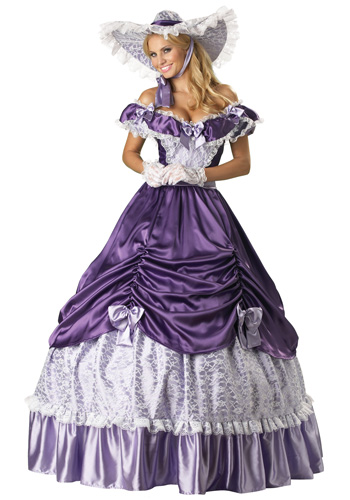
When something is described as “costume-y” what do you think of? Do you try to avoid this dreaded term being applied to your own projects?
Everyone has their own idea of what makes a garment or outfit look costume-y. Is it the fit? Or the fabrics used? Or a crappy sewing job? What about simply the attitude of the wearer, like how they present themselves in the costume?
Something that is pronounced “costume-y” is usually done in a negative light. It’s beneath those who are viewing it. But why? Are these costumes really that bad? And just what constitutes a costume-y costume? 🙂
Here are some elements one might apply to a costume that could be considered “costume-y.”
- Poor fit. You can have the most gorgeous fabric and use the finest sewing techniques, but if a bodice (or whatever part of the garment) is ill-fitting it destroys the entire look. Perhaps that dress is on a newbie costumer who has been sewing for years. Should it still be called costume-y? The fit of Regency & Victorian garments is well defined by the silhouette. Slip off even a little and it could fall into the dreaded pit.
- Cheap materials. I think this along with poor fit are the two highest points that define a costume-y costume. Polyester satin just doesn’t look right for a Civil War ball gown.
- Using modern colors. The Victorians loved their aniline dyes! Check out some museum collections and the colors just POP before your eyes – true red, kelly green, sapphire blue. But using a dusty rose, popular in the 1980s, might make that gown scream “costume.” Same is true of using modern print designs. In my research THEY did not use large floral chintz for dresses. That was reserved for window treatments.
- A costume that doesn’t look like ordinary clothing of the period. You know, a Gone With The Wind costume (chuckle). Especially in living history circles, one might judge another’s outfit as costume-y if the shoulder seams are set high with a modern placement. So if the seam placement on a costume is out of alignment with what we see in antique clothing, does that make it costume-y? Even if the fit is perfect?
- Something to dress up in for Halloween. This seems almost an obvious excuse to call something costume-y. It’s seen as not a real work of historical costuming. A costume-y costume is relegated to only being worn once a year in October and is not allowed to show itself in other months.
If an outfit is destined to only being worn for Halloween, which in general, is a time to show off, perhaps that costume-y thing should be described as clothing for the stage. That it doesn’t really represent a historical period of time.
Perhaps instead of a dress being viewed so low, it should simply be called “theatrical.” People understand “theatrical.” It’s exaggerated, dramatic. It’s not meant to be taken seriously. It gives clues to characters and references to places in time and location.
But costuming from the past is relative to the people you hang out with and the authenticity standards of the group or persons you are representing.
That dusty rose calico may be fine for a Jane Austen picnic because your group of friends only cares about dressing up to have fun. Whereas, museum docents would purposely avoid synthetic fabrics to present a truer appearance for a point of history based on the research available.
This comes back to poor fit. People throughout history have worn ill-fitting clothing. It’s nothing new. The 19th Century silhouette was so fitted to the figure and displayed in colorful fashion plates and touched-up photographs that we forget not everyone had “perfect” clothes.
It begs the question; back in the 1800s did they have a “costume-y” term for others’ badly-fitted, “theatrical” clothing? If someone today wears a too-loose shirt, we don’t call it costume-y. It’s just a person’s clothes.
And does a perfect-in-every-way-except-the-fit costume still scream “costume-y” when it’s so close to historical principles?
Perhaps “costume-y” in our definition is an arrangement of old-fashioned clothing that, to our modern eye, doesn’t look like it came from the period represented. Maybe we want it that way – something with a vintage touch. Maybe we don’t mind our costumes giving a historical appearance but with some modern elements like rayon trim on silk-like taffeta. Would they then still be considered costume-y? It rests on the eye of the beholder.
If our individual, modern eye is the judge perhaps all our work gives a costume-y appearance, at least to someone.
“Theatrical” just might be a better definition then as we who do historical costuming go on stage a few times a year to prance and parade in our finest work looking similar to those in our party. We’re all on a stage when we’re dressed up in past fashions.
What do you think?
Sinced I’ve started focusing my historical sewing towards the cosplay end of the spectrum I’ve learned a valuble lesson. Incremental upgrades. Your first ‘costume’ may be made using cheap materials and the wrong patterns but its always ONLY the FIRST Step’ towards your final outfit. a placeholder if you will. You make it you learn a whole load of stuff. Next year you tweak it, replace elements and add others. Till several years down the line you;ve got yourself a passable historical outfit rather than fancy dress costume. This is a great way to do it if you have like me a limited budget or are not confident with skills.
I’ve been supplimenting my ‘closet cosplays’ by sewing new more historically correct items to upgrade.
Exactly the way to do it! We all started with inappropriate fabrics and shaky steps. The only way to learn is to just start where you’re at and move forward. The skills and know-how come over time and with each project.
I had kind of the opposite thing happen to me at a non-costume-themed party. It was late December, but not everyone in the group celebrated one of the various religious holidays from that time of year – let alone the same holiday – so we called it a pre-emptive New Year’s party. I wore a green, long-sleeved, long-skirted dress. The bodice was based on an Elizabethan corset and the pleats of the skirt at the back waist suggested a bustle. Several people came up and asked me if I was dressed as a Victorian caroller – despite my lack of bonnet or muff or songbook, despite my very modern ponytail and glasses and nail polish, and despite the shiny polyester sateen my dress was made of. Ironically, I probably wouldn’t have been asked if I’d been in a patterned dress. A lot of people outside the historical costuming community seem to think printed patterned fabric wasn’t invented until the 1950s or so. On the other hand, I was a North American woman under the age of 30 wearing an ankle-length skirt in a non-formal setting, so maybe it’s not so shocking people thought I was in costume.
Just found your blog so I’m chiming in late with my response. I have to admit most of my costumes were probably “costume’y” because they were in fact done for theatrical reasons. And although I’d LOVE to have had all of them more authentic (and I do the best I can with what I have to work with in time, resources, etc.) I still have had great fun wearing them. Plus, usually the events I’ve attended, my costumes have always come the closest to the ‘real deal’ of anyone else in the room.
But oh, what a wonderful post and a wonderful way to present this dilemma to those of us who love dressing up and playing a part. Wonderful wonderful post.!
Thanks for the comment Connie. We all do the best we can with the resources we have but there is always room (and desire) for improvement. 🙂
I have certain ensembles for living history events and certain others for other events. My favorite period is the Civil War, so I have a camp dress, tea dress and modest ballgown. These are for living history events and community events in our town.
When I go to cosplayer events like DragonCon, I plan to wear a robe a la Francaise made out of pale green velvet embossed with glittery gold medallions. It will also be under lit with a number of LED lights programmed for movement or sound. Is it period correct? Of course not. I rationalize it by thinking that if Marie Antoinette had had these items available to her, she would have used them. It’s jsut for fun and the only thing remotely historical about it will be the style.
I’ve never done ‘living history’ per se, but did work in an historic house museum where we desired to attain period accuracy. Being a ‘house docent,’ I did not have a bonnet or outerwear. When invited to a Civil War event, I knew I
‘should’ have my head covered and went in search of bonnet supplies. The shop owner advised me of what to put on the bonnet (a typical ‘costume’ felt Bo Peep bonnet) and I went to town. I knew nothing of millinery or proper bonnet shapes for the period. I wasn’t at the event 5 minutes before a group of girls gathered snickering and pointing at me, sending one over to ‘over’ compliment my bonnet. It was done snarkily and with blatant sarcasm. I was 45 and she was probably 19. I was very polite, and pretended I had no idea I was being made fun of. I saw from her perfect bonnet that I was WAY off the mark. I chose to use it as a learning experience and study up on the millinery of different periods…and realized in the future, when I see the mistakes others make, that it may be their first event, their only event, their best effort, etc. I can only hope that by striving to not be ‘costumy’ that others may be encouraged to learn more to improve their own efforts.
That said, when I see those modern wedding hoops at any event I fervently want to run up and ask if I can please just adjust the bottom hoop so that their skirt looks the way it should.
I’m working on my first formal gown for Dickens this weekend and although I had chosen the fabric years ago as it resembled a silk 1840’s gown, I now worry I will look like a giant shining bouquet of obnoxiousness. And if someone is crass enough to point it out to me, I’ll let them know I have a mirror and realized it long before they did.
Great outlook going forward Robin!
Love your efforts! Keep doing what you do and enjoy your time. One day, you’ll be the one in the room with THE Best Dress on and you’ll be helping out those of us who are still learning.
I think it depends on the situation and your outlook as to what you aim for in historical accuracy.
I don’t have somewhere I re-enact historically*. But I love historical clothes so I will scour the internet for any chance to ‘dress up’. Most of the things I make I try to have so that I can split up elements dress them modern or combine and make look historical. I’ve done a bit of regency stuff and I’m sure I could do [late] edwardian (I incorporate so many elements of edwardian into my winter wardrobe I’m just the right shape for that era). The bustle era frightens me looks so complicated to get right so I’d be tempted to go steampunk instead.
My philosophy when making clothes is if I was that person back then what would I do? I try to immerse myself I’ll look over pinterest, books, old photo’s even films to try and get the right feel…before I sketch out an idea. Then I price it up. It has to cost less than £50 (yep that’s my budget) so I try to be thrifty. I’ve got quite good at eyeing up rtw clothes and seeing how close it is to the shape I’m looking for. I know I could never be really accurate as I wear glasses. (I have bought myself some round shaped metal rimmed glasses so it doesn’t look as achronistic)
Although I have to say my pet peeve is waistlines not being on the waistline. I went to one event the amount of times I saw a Regency dress that looked costumey because….the waistband was sitting on the middle of the bust and the hem of the dress was around the calf level. And twinned with straight undressed hair.
*Vintage on the other hand I find I can wear every day and there’s lindy hop events I can go to and dress 1940’s in as accurate a manner as I can. No BHS tea dresses for me. Repro patterns and accessories using instructions from a 1940’s newsreel.
Part of me love historical re-creations and part of me loves Theatrical costumes. I find it difficult to balance the two, so I do my research, then I do what I want. I’ve never been snarked and have never snarked another because we all have different priorities. I once bustled my 1860s gown, making it an approximation of an 1870s gown just so I could go to the function. I wasn’t historically correct and didn’t care, just went for the Tea. (Also, my hat was a purposely frothy confection made to loosely resemble the period but in no way made of accurate materials). And I had fun. I do agree that the demands of living history are certainly different than the “just for fun” events and would demand greater attention to detail but to denigrate someone’s efforts is…annoying, at best. Everyone has different interests, time and budget constraints, etc. The fact that we are all out there trying is what is important.
I think the definition of the term “costume-y” is an indivitual thing. I look at costumes from an historical perspective. My friend does not. She sees the color and spectacle and is satisfied. I look for historical accuracy and arachronisms, cultural mistakes, disregard for period , metaphorical or not, can ruin the show for me.
I agree with nicole. You wouldn’t believe the people that put on shows claiming to be experts and they can’t even get the period right.
Party store gowns- i haven’t seen anyone claim it was accurate- I mean you kinda have common sense and know its a mass produced costume. When I go to an event and see someone wearing one, usually its a young girl or someone new who- just had no idea what the period was about and usually within 1-2 years they have a general idea and hire a good seamstress or find a good pattern and sew — I have seen people give lectures and they have absolutely NO IDEA what they are talking about but because of a lack of books etc- they assume they are correct and think people will believe them. They make up their mind on what is correct and try to pass it off as the truth.
I read about people saying Garibaldi shirts and Zouave jackets weren’t accurate to the 1860s. It’s things like that that can get under the skin.
Or people adamantly insisting that corsets were torture devices made of leather.
I think it depends on your purpose for wearing said “costume”…if you are trying to teach the general public about the clothing of a particular period, then I think you should try to be as accurate as possible, within your own budget. If you are just “playing dress-up” for fun, then wear whatever you want, but don’t try to pass it off as historically accurate. It is not fair to those of us who work hard to strive for historical accuracy to have someone parading around in a party store halloween costume and telling the uneducated public that this is what folks wore.
I went to one event- it was HORRIBLE. There were people who wore costumes from costume shops – and 1980s prom gowns– you look at them and they feel great- and I am not the type of person to tell someone they are wrong- we are all there in good fun.. but I would watch these girls who were so called “experts” who were “designers” and their gowns were COMPLETELY wrong and worse off, they couldn’t sew!! I watched them walk up and laugh right in their face and make fun of them. I’ll never go to that weekend again. In my opinion, if someone is wrong- let them be wrong- its not like we are in the 1900s and high society.. they spent probably a TON of money on their costume and you basically just ruined their entire experience. Instead of them learning by observing and through classes etc- they are completely humiliated and don’t come back. I once had the dinner gown from titanic made, took 6 women 5 weeks to bead it– it was FULLY beaded and one of those same girls walked up- took her shoe and ground my train into the ground– it was silk- so do I need to tell you what happened? She over dramatically said “SORRY” and then laughed as she walked away.
People are catty and they need to get over it. I always vowed that if I went to another event again and saw this behavior, I would call them out- as loud as I can and tell point out their design flaws. I mean this one girl who claimed she was an expert wore the flying gown and it was like… “did you follow the instructions?” it was SOOOOOO wrong and panne velvet- and yet she had the nerve to call out a 15 year old girl who was there with her parents and felt good about herself. People need to grow up.
>back in the 1800s did they have a “costume-y” term for others’ badly-fitted, >“theatrical” clothing?
I believe it was called poor sewing skills. Or poor housewifery, which is even more insulting.
Put me in the corner with the people who can’t stand seeing limp hair and modern eyewear atop a period dress. Even if the dress is polyester, and isn’t worn over a corset, I’ll forgive the girl if she at least made an effort to put her hair up.
Beyond that, yeah–the levels of snarkiness and/or approval kind of depends on the group you hang with/infiltrate. I quit going to one local con because their idea of costuming ran to trashy visual puns and in-jokes. I’m not bitter, merely contemptuous.
I think it all goes back to knowing your audience: what you are wearing for what occasion, and being happy and comfortable. Just because not everyone “gets it” doesn’t mean it’s a bad effort. I’m not going to wear the same thing to a Steampunk Con as a Regency Tea, but if anyone gave me crap at either event for not being accurate enough, well, then they can blow it out their teapot. Everyone starts somewhere, everyone does their best with the skills they have at the time, and I’ll encourage creativity even if it starts with an acetate satin.
Absolutely!
I think a lot of it comes to giving people a chance to improve. It takes time to develop an eye. So gentle kindness & encouragement will make a person want to improve, while snarking makes us want to give up.
Hear, hear.
Sooo. I guess I am one of the mean, ‘snarky’ ones.
We did a living history this past weekend, (WBS/Civil War), that got a lot of media coverage for our group. 2 TV channels, newspapers, etc…
We had a ‘newbie’ join us with an 1867 bustled RED skirt and from the waist up, she could have joined me where I volunteer, in a 1905 house. Pure giant Gibson Girl hairpiece with requisite HUGE hat covered in frufru and ostrich feathers along with narrow heeled, white leather and lace can-can girl boots.
I saw how proud she was of her outfit, but when she asked me what I thought, I had to tell her that although I loved the outfit and the way it looked, it was more suited to where I volunteer (1890’s to 1905) than the early 1860’s. (Strangely enough, someone whom is a sutler told her the very same thing…) Neither of us bothered too discuss ‘proper foundations’ with her.
I told her she could look at the 3 books I brought to get a better idea of the period she was trying to represent. I also told about the ‘snarky b****’ that verbally jumped me at the first re-enactment I attended at which I commented on the fact I would like to get involved and attire myself. (what a story that is…)
OK, so maybe I can be a ‘stitch counter’. I am not so fanatical that I think that everyone’s outfits should be real silk. Nice poly-taffeta in a period correct pattern will have to do for my ‘better’ gowns. (Besides, I can’t continually pay for the dry cleaning of any silk dresses that would get caught in the Florida deluges, let alone the mud/heat of battlefield re-enactment camps.)
That being said, I chose NOT to keep my mouth shut about something that reflects upon our group.
So, say what you will, I think there is a time and place to say something. And I did.
Of course there are times when something can be said. But it comes down to HOW you speak it and instruct the person. No one likes unsolicited advice so be sure the newbie wants to hear your opinion and improve on her costuming. If going for close to historical accuracy, by all means instruction should be given and received.
I can agree with the cheap “costume-y” look. The stretchy panne velvet is horrible. Some things should be forgivable like color and fit because they are more “personal”. I know I look ghastly horrible in true red. It would overcome my skin tone. Now I would choose a cool muted light green to complement my skin.
Talking about fitting, I would love to do a Victorian-inspired outfit but I don’t know how the fashionable plus size ladies of that time have their garments tailored to fit them while still keeping them fashionable. So for a novice sewist like me, I would definitely be using a modern pattern until I can learn how to alter an old one.
Try Truly Victorian patterns, which are pretty much customizable to all sizes. We have plenty of pictures at the museum of very robust ladies in very fashionable costumes — they’re really no different than the prevailing trends of the time, just larger.
Thank you. I have heard + seen great things about Truly Victorian patterns and I hope to get some of their patterns in the future.
Do you have a link to the museum you are talking about? I would love to see the pictures for inspiration.
No, they don’t have anything on their website. But look at photos of the mature Queen Victoria, for example.
I think this also comes down to foundation garments. As long as the outfit is worn over “correct” underpinnings, then it will look alright, no matter your size. A lot of people seem to make the mistake of assuming that if a corset is not going to cinch your waist enough to create the fashionable silhouette of the era, then you might as well not wear it at all. Which is simply not true, it makes all the difference!
This is so true! That’s why you fake that small waist by emphasizing the shoulders and hemline.
this is amusing,as I found people are drawn to the “Costume-ey” outfits over the period correct ones everytime. My friend commisioned me to make her a “Noble” outfit for our Southern Calif Ren faire. She chose: Red burn out velvet ,gold sheer embossed fabric for the chemise,a lurex gold print for a panel in the front of the bodice and a matching forpart. She also wanted it fitted VERY tightly to her figure and not wear a corset of anykind. I made her a pill box to wear at the back of her head,:she wore it placaed directly in the center of the crown of her head (Think organ grinders monkey) . I accompanied her in my period correct noble gown, Multiple people stopped her to take her pix…. I was flabergasted…It was SO wrong. BUT to theMundanes,she was the peach!.
I cannot wear this kind of garment in good concious, but thats just me.
I am cynically wondering if this friend who kept getting stopped for pictures was conventionally skinny and pretty and outgoing? Because cute girls get stopped for pictures no matter how lame their costume. Sad but true.
This was a great article. And I think all the comments people left were very interesting. I especially agree with Chantal’s. Correct undergarments are SOOOO important. A wrong silhouette can completely derail even the best dressmaking.
Not everyone can afford expensive fabrics and not everyone has long hair they can do up in a period correct do (but you can always get a wig). Some people are new to costuming and don’t have it quite down yet. But overall, I think what makes things “costumey” is a lack of effort and a lack of research. Halloween costumes are totally another story. I like how they can be referred to as “theatrical.” Some costuming is just for fun.
And as for the meanies who step on other people’s efforts and hard word, screw off. Who cares how “bad” another person’s outfit is. You don’t have to wear it. If there is one thing that is worse than the person with the costumey outfit, it’s the know-it-all who has to say something about it. Very unbecoming.
In my mind, “Costumey” is not so much about poor fit, or using synthetic trims(natural fibre trims where are you??) but the grating disregard to mixing eras, refusing to do history hair-dos, violently inaccurate foundation garments, — yeah, its a whole aura. We are all somewhere on the scale of costuming, and I know how to squint to see what the creator had intended. Halloween costumes or theatre — sure, do whatever works. That is entirely different from historical costumes. I just have a hard time enjoying blatant errors that with a little more effort could be sooo much better.
ps — Karen, the comment about the costume for the bulldog CRACKS me up!
I agree with Val about the lace. Some ensembles end up looking like they were created with a pastry tube and contrary to known embellishments of the period. Having said that, I am preparing to put gathered period-looking (but not period) lace onto the bottom af an 1890’s gown for this weekend, guided by one of Katy Bishop’s illustrations in one of her books. I think a good rule of thumb might be “Less is More.” And sometimes, for a new costumer, the more expensive fabrics are heart stopping. When I began this passion (hobby? obsession?) nine years ago I made an 1870’s ballgown skirt out of black poly satin because my skills were so rusty, and $12/yd silk taffeta was making me choke. . . Thankfully I had someone well-versed advising me, and we selected a more period-appropriate gold brocade for the bodice. Thus the ensemble still reads well, and I still wear it to events. And of course it depends on the event: if it is a more “costume-y” event populated with people who are not participants in our own brand of dementia, accept it for what it is. Which is why I didn’t choke (too badly!) last Saturday night when, at a costume party given by one of Bill’s Shriner friends, it was announced that my lovely Titanic gown came in second to a red acetate pirate outfit. Although I didn’t know everyone was in competition, I DID have to throw in that it was a Titanic gown when I was announced as “the Victorian Lady!.” (Another discussion, another time. . . .) However, given that time is so precious, I draw the line at spending my time making costumes on demand for friends pets. Five yrs ago I steadfastly refused to make a Mexican Lucha Libre wrestling costume and mask for the English bulldog of my trainer! Anybody else ever been put in that position?
I just snorted tea all over my keyboard at my mental image of a bulldog in a Lucha Libre costume. Thank you for such a good laugh!
(This coming from someone who once spent two weeks on a tiny, fitted mask and hat for my cat’s Phantom of the Opera Halloween costume… He hated it.)
My pet peeve is the use of modern polyester lace, especially when most likely lace wouldn’t have been used during that period. The better choice would be self fabric ruffles, or a contrasting fabric.
Sometimes, even a perfect period dress and authentic accessories can be spoiled by the wearer’s hair-coloring and styling. I know we have to live in the modern world too, but to carry off a successful period look, the viewer must be able to “suspend disbelief”, forgetting he or she is in the 21st century, looking at a modern person in period clothing. This just can’t happen with streaked, colored hair, especially if the roots of a different color are obvious. I know…nit-picky! But…it is what it is.
Bonnie, you are correct. I think if you’re going to wear a historical costume one should strive to look the part. But it all comes over time as we’ve all had to learn. And wigs/hairpieces rock! 🙂
I know a lady who has lovely, accurate dresses made to fit her like a glove. She wears very heavy make up and to me she looks like an old harpy. When I am in my reproduction clothing I feel free, but I know some women do not feel comfortable giving up their make up and showing their face.
Ditto for modern eyewear, especially big plastic frames.
Great article, but I’m not sure how to answer what I think. Everyone has their own reasons and purposes for making and wearing costumes, as you say. Where does the perfectly-fitting, sewn-with-historical-methods, but using faux silk ensemble fit in? Is it still costumey? Does it matter?
I think it’s really up to the individual and what makes them gleeful. One should enjoy wearing something they made, especially a stab at a historical costume. Nothing is worse than spending ages on a costume, wearing it out to an event, and having some snark come up to you and tell you everything that’s wrong with it. We all know this happens, and most of us have had it happen to us or a friend directly. Some people have the thick skin to tell those snarks to “f-off,” but most of us are really hurt by such comments, and what is the result? The entire experience of making and wearing something you created is ruined.
For most of us, costuming is a hobby. Nothing but the promise of having a good time is compelling most of us to put on a Regency frock, or a bustle dress, or a robe a l’Anglaise. When that good time is ruined by stitch nazis and garb snarks, then there’s no reason to do it anymore.
Sorry, I’m ranting. I’ll stop now! But yes, your article here really makes me think…
I totally agree with you Lauren! And yes, when a hobby becomes not-fun and negativity abounds, people stop. Most of us do costuming because it’s fun, and I don’t intend to stop them if it’s something they want to do.
“Costume-y” is our own personal judgement on someone else’s work. Who are we to crush their dreams?